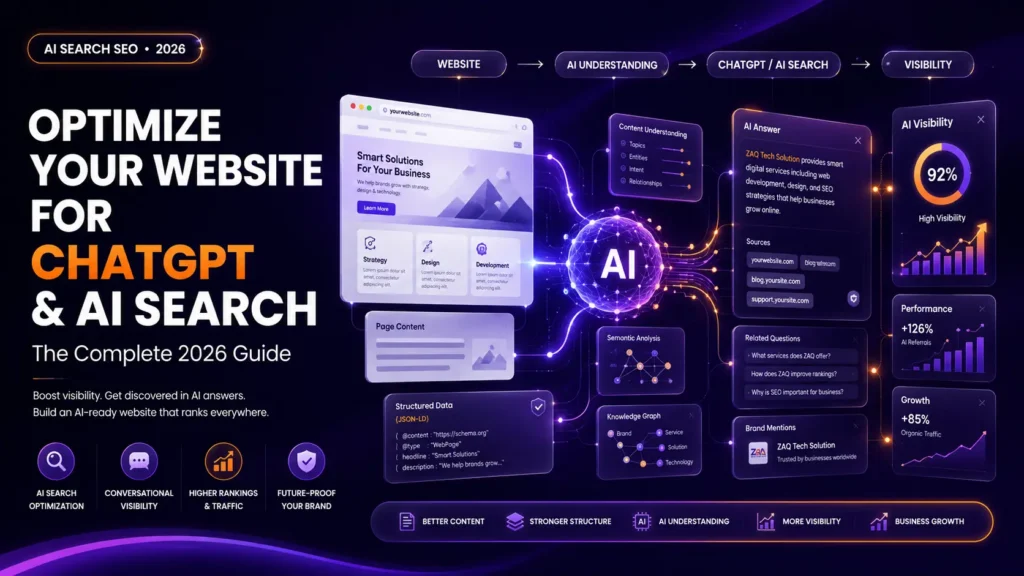
You’ve noticed it too — fewer clicks, same rankings. That’s because your customers aren’t just Googling anymore. They’re asking ChatGPT, Perplexity, and Gemini directly, and if your website isn’t built for those engines, you simply don’t exist in the answer.
Here’s the good news: you can fix that. This guide walks you through exactly how to optimize your website for ChatGPT and AI search — step by step, with no fluff and no guesswork.
By the end, you’ll know how to structure content, mark up your site, and set up the technical foundation (including the new llms.txt standard) so that AI engines can find you, understand you, and — most importantly — cite you.
What Does It Mean to Optimize for AI Search?
Optimizing a website for AI search means structuring your content so AI models like ChatGPT, Gemini, Claude, and Perplexity can crawl, understand, and cite it as a source in generated answers. This includes clean HTML, answer-first writing, schema markup, and AI crawler access — not just traditional keyword ranking.
Think of it this way: Google SEO gets you a blue link. AI search optimization gets you mentioned inside the answer itself, often with a citation and a click.
Why AI Search Optimization Matters in 2026
The shift isn’t coming — it’s already here.
- More searches now start and end inside a chat window, never touching a traditional results page.
- AI Overviews on Google now appear above organic listings for a large share of informational queries.
- Perplexity and ChatGPT both link out to sources, meaning citation-worthy pages still get real traffic.
- Buyers increasingly ask AI tools to “recommend” or “compare” services before visiting any website at all.
: if your competitor’s site is cited inside ChatGPT’s answer and yours isn’t, they’re winning the customer before you even get a chance.
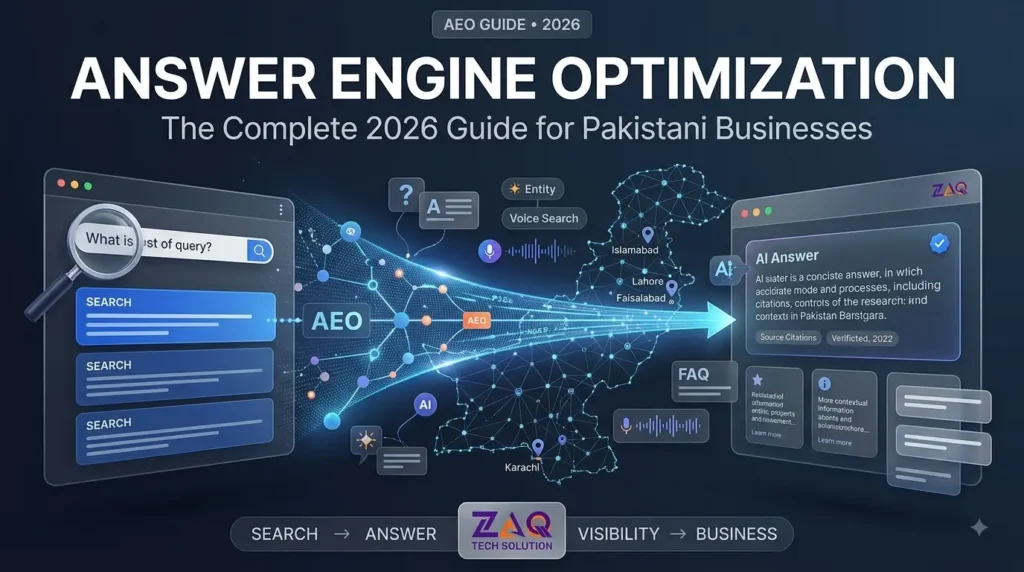
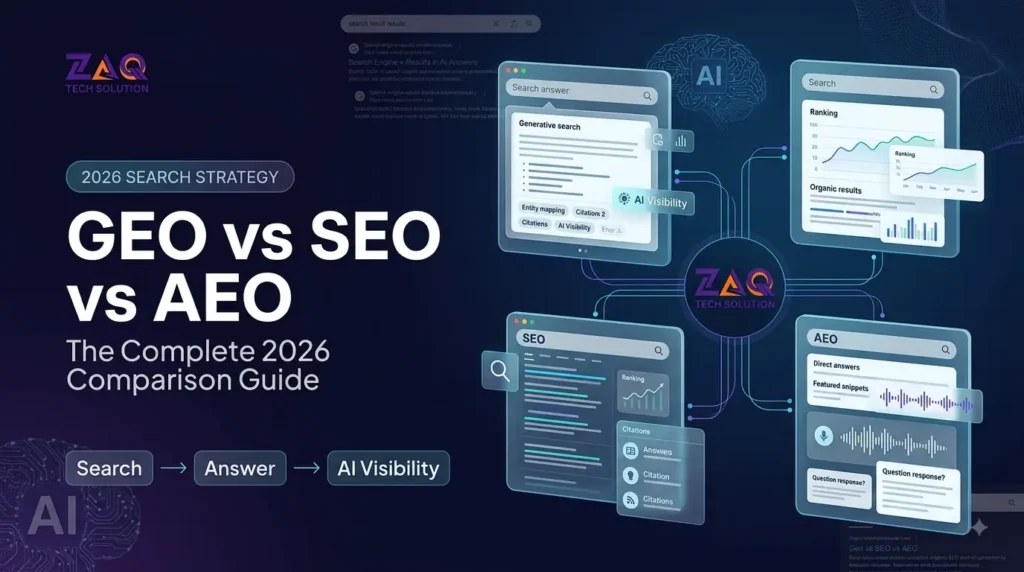
SEO vs GEO vs AEO: What’s the Difference?
These three terms get mixed up constantly. Here’s the simple breakdown.
| Term | Full Form | Goal | Primary Engine |
| SEO | Search Engine Optimization | Rank on Google’s results page | Google, Bing |
| GEO | Generative Engine Optimization | Get referenced inside AI-generated answers | ChatGPT, Gemini, Perplexity |
| AEO | Answer Engine Optimization | Provide the single best direct answer to a question | Voice search, snippets, AI overviews |
Practical takeaway: you don’t need to pick one. A well-built content strategy in 2026 layers all three — clean technical SEO as the foundation, answer-first structure for AEO, and AI-crawlable, citation-friendly formatting for GEO.
How ChatGPT and AI Engines Actually Choose Sources
AI search tools don’t “rank” websites the way Google does. Instead, they retrieve and synthesize information from sources that are:
- Crawlable — the AI’s bot (like GPTBot or PerplexityBot) can actually access the page.
- Clear and well-structured — headings, lists, and short paragraphs are easier to extract than dense blocks of text.
- Fact-dense — statements with specific numbers, definitions, and dates get pulled more often than vague marketing copy.
- Trustworthy — sites with authorship, real business info, and consistent citations elsewhere on the web score higher on trust signals.
- Recently updated — freshness matters more to generative engines than to traditional SEO.
If a page fails any of these checks, it’s effectively invisible to AI — no matter how well it ranks on Google.
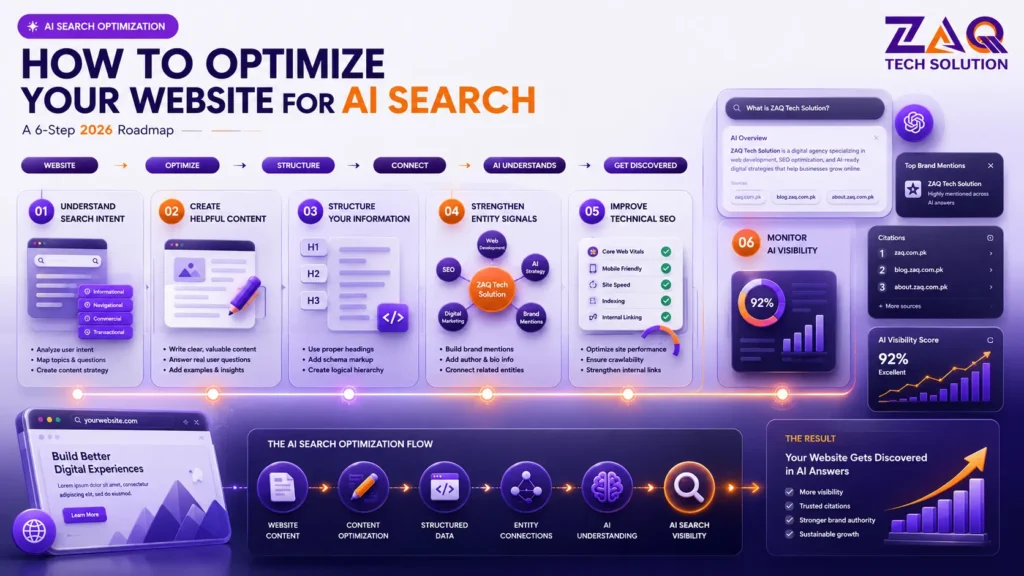
Step-by-Step: How to Optimize Your Website for ChatGPT and AI Search
1. Make Your Site Crawlable for AI Bots
Check your robots.txt file. Many sites unknowingly block AI crawlers like GPTBot, PerplexityBot, Google-Extended, and ClaudeBot.
- Allow relevant AI user-agents unless you have a specific reason to block them.
- Confirm your pages aren’t hidden behind heavy JavaScript rendering that bots can’t parse.
- Submit an updated XML sitemap and keep it error-free.
2. Write Answer-First Content
AI models favor content that answers the question in the first 2-3 sentences, then expands with detail.
- Open every page or section with a direct, factual answer.
- Follow with supporting context, examples, and data.
- Avoid long introductions before getting to the point — AI engines (and readers) skip past them.
3. Structure Content With Clear Headings
Use a logical H1 → H2 → H3 → H4 hierarchy. This isn’t just for humans — it’s how AI models “chunk” your page into extractable pieces.
- One H1 per page.
- H2s for major sections, H3/H4 for sub-points.
- Keep headings phrased as questions where natural (“What is GEO?”, “How much does AI SEO cost?”).
4. Add FAQ Sections With Schema Markup
FAQs formatted with FAQPage schema are some of the most frequently cited content blocks by AI engines, because the Q&A format matches how people query chatbots.
5. Build Topical Authority With Entity-Based Content
Cover a topic comprehensively rather than writing thin, keyword-stuffed pages. Link related concepts (SEO, GEO, AEO, schema, llms.txt) together so search engines and AI models understand the full topic cluster you own.
6. Keep Paragraphs Short and Scannable
2-3 line paragraphs, bullet points, and numbered lists all improve extractability — both for Google’s Featured Snippets and for AI-generated summaries.
7. Earn Real Citations and Mentions
AI trust models weigh external validation heavily. Guest posts, directory listings, press mentions, and backlinks from authoritative Pakistani and global sites all reinforce that your business is real and credible.
8. Publish Fresh, Dated Content
Update cornerstone pages regularly and show a visible “last updated” date. Generative engines are more likely to surface recently refreshed content over stale pages from years ago.
Schema Markup for AI Search Visibility
Schema (structured data) is a translation layer — it tells search engines and AI crawlers exactly what your content means, not just what it says.
Priority schema types for AI search visibility:
| Schema Type | Purpose | Where to Use |
| Organization | Confirms who you are | Homepage |
| FAQPage | Marks Q&A content for direct extraction | Blog posts, service pages |
| Article / BlogPosting | Identifies authorship and publish date | Blog content |
| Service | Describes specific offerings | Service pages |
| LocalBusiness | Confirms location and contact trust signals | Contact/About pages |
| BreadcrumbList | Clarifies site structure | All pages |
Expert tip: Validate every schema block using Google’s Rich Results Test before publishing — broken schema is often worse than no schema at all.
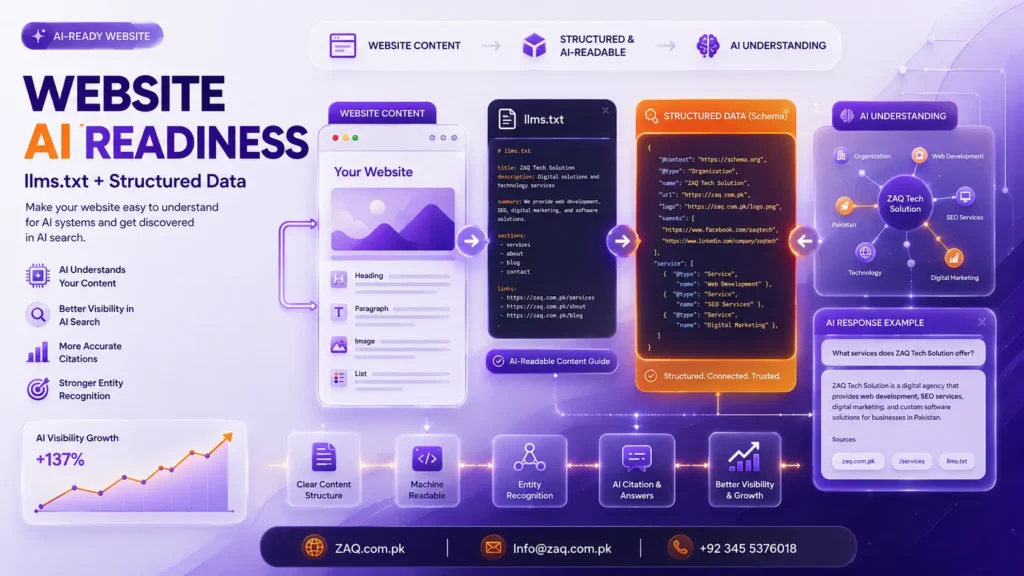
Website AI Readiness: llms.txt and Structured Data
llms.txt is an emerging standard — essentially a robots.txt for AI models. It’s a plain-text file at your site root that gives large language models a curated, structured summary of your most important pages.
A basic AI-readiness checklist:
- [ ] Add an llms.txt file listing key pages, services, and a short site summary.
- [ ] Keep robots.txt open to major AI crawlers.
- [ ] Add structured data (schema) across core pages.
- [ ] Ensure fast load times and mobile responsiveness — AI crawlers deprioritize slow, broken pages.
- [ ] Maintain a clean URL structure and internal linking.
- [ ] Publish an About/Author page that establishes real expertise (EEAT).
Sites that complete this checklist are significantly more “readable” to both AI crawlers and human visitors — which is exactly the point of AI readiness.
How to Get Cited by ChatGPT and Perplexity
Getting cited isn’t about tricking the algorithm — it’s about becoming the clearest, most trustworthy source on a given topic.
What actually increases citation odds:
- Direct, factual, well-sourced answers in the first few lines of a page.
- Original data, statistics, or case studies AI can’t get anywhere else.
- Consistent structured formatting (headings, lists, tables, FAQs).
- Strong domain trust signals — HTTPS, clear authorship, business transparency.
- Presence across multiple credible platforms (not just your own site).
To get cited by ChatGPT and Perplexity, publish clear, well-structured, fact-based content with FAQ schema, fast page speed, and open AI-crawler access — then reinforce it with credible mentions across the web.
Cost of AI SEO Services in Pakistan
Pricing for AI SEO and GEO services in Pakistan varies based on scope, industry, and how competitive your niche is.
| Service Tier | Typical Monthly Range (PKR) | What’s Included |
| Starter | 25,000 – 50,000 | Basic technical SEO + AI crawlability audit |
| Growth | 50,000 – 120,000 | Content optimization, schema markup, FAQ pages |
| Enterprise | 120,000+ | Full GEO/AEO strategy, llms.txt setup, ongoing content and authority building |
Exact pricing depends on your industry, current site condition, and competition — request a custom quote for an accurate figure.
Expert Tips for ChatGPT SEO Strategy 2026
- Treat every page as a potential AI answer, not just a ranking target.
- Don’t abandon traditional SEO — AI models still lean heavily on well-established, well-linked domains.
- Update your FAQ pages quarterly as new customer questions emerge.
- Track AI referral traffic separately in analytics (ChatGPT, Perplexity, and Gemini now show up as distinct referral sources).
- Audit your llms.txt and schema every few months — standards are evolving fast in this space.
FAQs
Q1: What is AI search optimization (GEO)?
A: GEO (Generative Engine Optimization) is the practice of structuring website content so AI tools like ChatGPT, Gemini, and Perplexity can find, understand, and cite it in generated answers.
Q2: How is GEO different from traditional SEO?
A: Traditional SEO targets ranking positions on a search results page. GEO targets being referenced or quoted directly inside an AI-generated answer, regardless of page rank.
Q3: Do I need llms.txt for AI search visibility?
A: It’s not mandatory yet, but it’s a strong, low-effort signal that gives AI models a clear summary of your site — and adoption is growing fast among AI-forward businesses.
Q4: How long does it take to see AI search results?
A: Most sites see initial AI crawler activity and early citations within 4-8 weeks of implementing structured content and schema, though full authority-building takes longer, similar to traditional SEO timelines.
Q5: Can a small business in Pakistan compete for AI search visibility?
A: Yes. AI engines favor clarity and trust signals over sheer domain size, which means well-structured local business content can compete effectively against larger, less-organized competitors.
Q6: Does ZAQ Tech offer AI SEO services in Pakistan?
A: Yes. ZAQ Tech provides technical SEO, schema markup, and AI-readiness optimization for businesses across Rawalpindi, Islamabad, Lahore, and Karachi, alongside its core web development and digital marketing services.
Looking to make your website AI-search ready? ZAQ Tech’s SEO team in Pakistan builds the technical foundation — schema markup, structured content, and AI crawlability — that gets businesses found by both Google and AI engines like ChatGPT and Perplexity. Get in touch for a free AI-readiness audit.
Pingback: Best SEO Company in Pakistan | Expert SEO Services