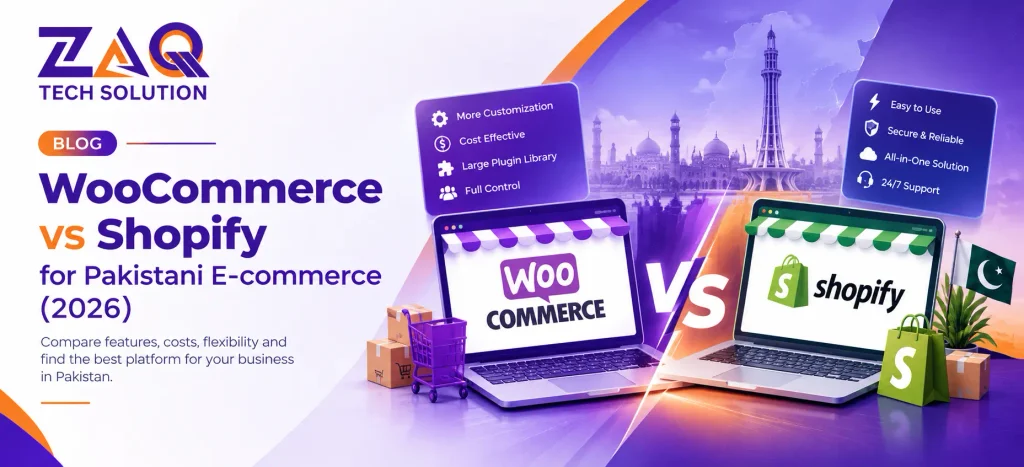
If you’ve read five different “Shopify vs WooCommerce” articles and still don’t know which one fits your Pakistani business, that’s a fair place to be stuck.
Here’s the thing most global comparisons miss: they’re written for US and UK sellers, where Shopify’s payment ecosystem just works. Pakistan is a different market with different rules.
We promise to fix that gap. This guide compares both platforms specifically through a Pakistani lens — payments, pricing, SEO, and hosting.
Here’s what we’ll cover: local payment gateway support, real cost comparisons, SEO control differences, hosting flexibility, and a straight, unbiased verdict on which platform fits which kind of seller.
This comparison is written by ZAQ Tech, a Pakistan-based web development company that builds WooCommerce stores with native JazzCash and EasyPaisa integration.
Quick Answer (For Readers in a Hurry)
For Pakistani e-commerce, WooCommerce is generally the better choice — it offers native JazzCash/EasyPaisa payment plugins, lower total cost of ownership, and deeper SEO control. Shopify is better if you want a fast, hosted, beginner-friendly setup and don’t mind working around local payment limitations. Neither is universally “best” — the right choice depends on your technical comfort and payment needs.
What Is WooCommerce? What Is Shopify?
WooCommerce is a free, open-source e-commerce plugin for WordPress that turns a website into a fully functional online store, giving you full ownership of your code, data, and hosting.
Shopify is a paid, fully hosted e-commerce platform that handles hosting, security, and updates for you in exchange for a monthly subscription.
The core difference is ownership and control — WooCommerce is self-hosted and highly customizable, while Shopify is a managed, all-in-one platform that trades flexibility for convenience.
Why This Comparison Is Different for Pakistan
Most “WooCommerce vs Shopify” articles online are written from a US/UK/global perspective — and it shows.
Global guides usually crown Shopify the winner because of its plug-and-play payment gateways (Shopify Payments, Stripe, PayPal) that “just work” in Western markets.
That advantage disappears in Pakistan. Shopify Payments isn’t available here, PayPal has no local payout option, and Stripe support is limited — so Pakistani Shopify merchants end up relying on third-party payment apps anyway.
WooCommerce, by contrast, has native, well-supported plugins for JazzCash, EasyPaisa, and COD, because it’s open-source and Pakistani developers have built directly for the local market.
Before trusting any global “best platform” ranking, always check whether it accounts for your country’s specific payment infrastructure — it changes the answer completely.
WooCommerce JazzCash & EasyPaisa Integration vs Shopify
This is the single biggest differentiator for Pakistani sellers.
WooCommerce Payment Support
- JazzCash — official and third-party plugins integrate directly into WooCommerce checkout
- EasyPaisa — same native plugin-based integration
- Cash on Delivery (COD) — built-in as a default payment option
- Bank transfer — supported via standard WooCommerce payment methods.
Shopify Payment Support
- JazzCash/EasyPaisa — not natively supported; requires third-party apps or custom API workarounds
- Shopify Payments — not available in Pakistan
- PayPal — no direct payout to Pakistani bank accounts
- COD — supported, but often needs an app for full flexibility.
Does Shopify support JazzCash and EasyPaisa in Pakistan? Not natively — Shopify merchants need third-party apps or custom development to accept JazzCash or EasyPaisa, while WooCommerce supports both through direct, well-maintained plugins built specifically for the Pakistani market.
If you’re setting this up for the first time, our guide on how to start an online store in Pakistan walks through the full JazzCash/EasyPaisa/COD setup step by step.
Shopify vs WooCommerce Pricing Comparison
Pricing structures are fundamentally different, so a fair comparison needs total cost of ownership, not just the sticker price.
| Cost Component | WooCommerce | Shopify |
| Platform license | Free (open-source) | $25–$65+/month subscription |
| Hosting | $5–$20/month (self-managed or local host) | Included in subscription |
| Theme | Free–$100 one-time (many free options) | Free–$350 one-time |
| Essential plugins/apps | Mostly free or low one-time cost | Often $10–$50/month combined |
| Estimated annual cost | Roughly $2,400–$4,800/year (with development/maintenance) | Roughly $2,988+/year, before added app subscriptions |
WooCommerce generally has a lower total cost of ownership than Shopify over time, mainly because it avoids recurring platform subscription fees — though it may require more upfront development effort or a developer’s help to set up.
Shopify vs WooCommerce Transaction Fees
Transaction fees are where Shopify’s cost structure often surprises new sellers.
- Shopify: Charges an additional transaction fee (typically around 2%) on every sale if you’re not using Shopify Payments — which Pakistani merchants can’t use anyway, since it’s unavailable locally
- WooCommerce: No platform-level transaction fee — you only pay whatever fee your chosen payment gateway (JazzCash, EasyPaisa, or a card processor) charges directly.
WooCommerce doesn’t charge its own transaction fees, while Shopify typically adds an extra 2% fee on top of third-party payment processing for merchants who can’t use Shopify Payments — which includes most Pakistani sellers.
Always calculate your effective transaction cost — platform fee plus payment gateway fee combined — before comparing platforms on price alone.
WooCommerce SEO Advantages
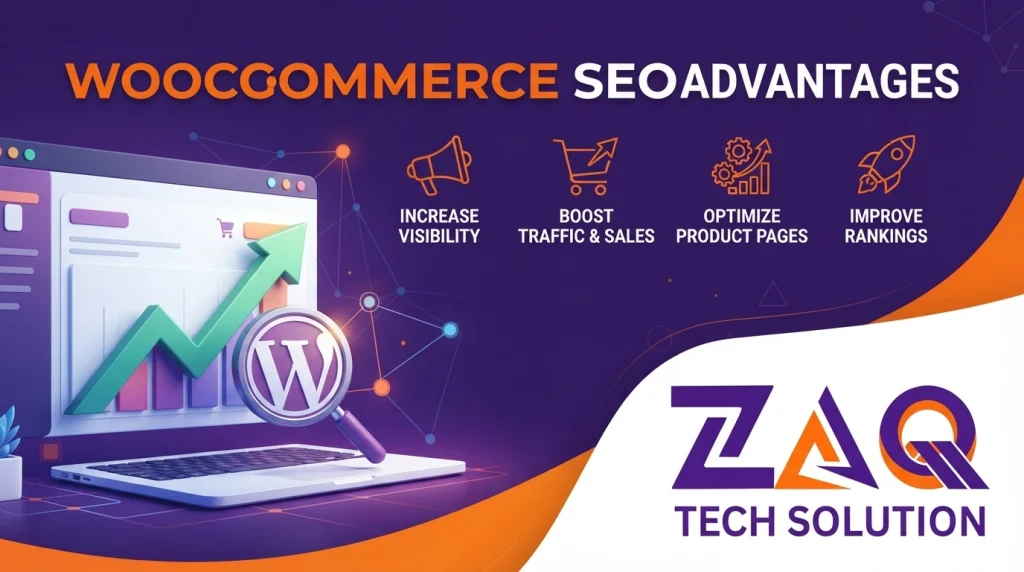
Since WooCommerce runs on WordPress, it inherits WordPress’s deep SEO flexibility.
Where WooCommerce Pulls Ahead
- Full URL structure control — clean, keyword-friendly permalinks
- Canonical tag management — critical for avoiding duplicate-content issues on product/category pages
- Native blog integration — content marketing lives on the same domain, consolidating SEO authority
- Plugin-level SEO control (Yoast, Rank Math) — schema markup, meta control, and technical SEO down to the field level.
Shopify’s SEO Limitations
- Less flexible URL structures — some URL patterns (like /products/ or /collections/) can’t be fully customized
- Blog is more limited compared to WordPress’s native content tools
- Theme-dependent technical SEO — more reliant on app support for advanced schema.
WooCommerce offers stronger SEO advantages than Shopify because it provides granular control over URL structure, canonical tags, and on-page technical SEO — all factors that directly affect organic search visibility.
Hosting Flexibility in Pakistan
WooCommerce lets you choose where your store lives — a meaningful advantage for local sellers.
- Local Pakistani hosting providers are available for WooCommerce, which can improve load speed for local customers and simplify billing in PKR
- International hosting is also an option if you need global reach
- Shopify, by contrast, is a closed, hosted system — you don’t choose or control the hosting environment at all.
If most of your customers are in Pakistan, hosting geographically closer to them (or using a CDN) noticeably improves page load speed — a direct ranking and conversion factor.
Ease of Use: Where Shopify Wins
To be fair to Shopify, it does have real advantages — and pretending otherwise wouldn’t be honest.
- Faster initial setup — a working store can go live in hours, not days
- No hosting/server management — everything is handled for you
- Cleaner learning curve for non-technical founders
- App marketplace is large and well-documented for common features.
Shopify’s biggest advantage is ease of use — it’s the better choice for non-technical founders who want to launch fast without managing hosting, plugins, or updates themselves.
Best Ecommerce Platform for Small Business in Pakistan
For small, budget-conscious Pakistani businesses specifically, the decision usually comes down to two questions:
- Do you have (or can you hire) basic technical help? If yes, WooCommerce’s lower long-term cost and payment flexibility usually wins.
- Do you need to launch this week with zero technical involvement? Shopify’s speed may be worth the higher cost — temporarily.
The best e-commerce platform for small businesses in Pakistan is typically WooCommerce, due to lower total cost of ownership, native JazzCash/EasyPaisa payment support, and stronger SEO control — Shopify remains a valid option for sellers who prioritize speed and simplicity over cost.
Side-by-Side Comparison Table
| Factor | WooCommerce | Shopify |
| JazzCash/EasyPaisa support | Native plugins | Requires workarounds/apps |
| Platform cost | Free (pay for hosting) | $25–$65+/month |
| Transaction fees | None at platform level | ~2% extra without Shopify Payments |
| SEO control | High (full URL/canonical control) | Moderate (some structural limits) |
| Hosting flexibility | Full choice, including local Pakistani hosts | None — fully hosted by Shopify |
| Setup speed | Slower, more technical | Fast, beginner-friendly |
| Ownership of store/data | Full | Partial |
| Best for | Cost-conscious, SEO-focused, long-term brands | Fast-launch, non-technical merchants |
Our Honest Verdict
Neither platform is universally “better” — but for Pakistani e-commerce specifically, the balance tips toward WooCommerce for most sellers.
Choose Shopify if:
- You want to launch within days with zero technical setup
- You’re comfortable paying a monthly subscription plus app costs
- You’re fine working around local payment gateway limitations.
Choose WooCommerce if:
- JazzCash and EasyPaisa integration matters to your customer base
- You want full SEO control to grow organic traffic long-term
- You want to avoid recurring platform fees and own your store outright
- You’re building for the long term, not just a quick test.
For most Pakistani sellers focused on long-term growth, local payments, and cost control, WooCommerce is the stronger choice — Shopify remains a reasonable option only for sellers prioritizing launch speed over local payment flexibility and cost.
Why Work With a WooCommerce Development Company in Pakistan
ZAQ Tech builds WooCommerce stores for Pakistani businesses with JazzCash, EasyPaisa, and COD integration handled from day one — not bolted on later.
What working with a dedicated WooCommerce team gets you:
- Native local payment integration, tested and configured properly
- SEO-ready theme structure from launch — clean URLs, schema, and speed optimization
- Custom design, not a generic template that looks like everyone else’s store
- Ongoing maintenance and support after launch.
If you’re still deciding on your broader development partner, our guide on how to choose the right software development company in Pakistan covers the full evaluation checklist. And if you want real numbers before you commit, see our breakdown of website development cost in Pakistan.
FAQs
Q1: Which is better — Shopify or WooCommerce for Pakistan?
A: WooCommerce is generally better for Pakistani sellers due to native JazzCash/EasyPaisa payment support, lower total cost of ownership, and stronger SEO control. Shopify suits sellers who prioritize a fast, hosted setup over local payment flexibility and cost.
Q2: Does Shopify support JazzCash and EasyPaisa in Pakistan?
A: No, not natively. Shopify merchants need third-party apps or custom API integrations to accept JazzCash or EasyPaisa, while WooCommerce supports both directly through dedicated plugins built for the Pakistani market.
Q3: Is WooCommerce cheaper than Shopify?
A: Yes, in most cases. WooCommerce has no mandatory subscription fee — you only pay for hosting and optional plugins — while Shopify requires a recurring monthly subscription plus potential app costs and transaction fees.
Q4: Does WooCommerce charge transaction fees?
A: No, WooCommerce itself doesn’t charge transaction fees. You only pay the fees charged by your chosen payment gateway, such as JazzCash, EasyPaisa, or a card processor.
Q5: Is WooCommerce good for SEO?
A: Yes, WooCommerce offers strong SEO advantages because it runs on WordPress, giving you full control over URL structure, canonical tags, meta data, and technical SEO through plugins like Yoast or Rank Math.
Q6: Which platform is easier for beginners — Shopify or WooCommerce?
A: Shopify is easier for beginners because it’s fully hosted, requires no server management, and can be set up in hours. WooCommerce has a steeper learning curve but offers more control and lower long-term costs.
Q7: Can I switch from Shopify to WooCommerce later?
A: Yes, migration is possible and common — product data, customer records, and order history can be exported and imported, though a developer’s help is recommended to preserve SEO rankings and avoid broken URLs during the switch.
Q8: What is the best e-commerce platform for a small business in Pakistan?
A: WooCommerce is typically the best fit for small Pakistani businesses due to lower costs, native local payment support, and better long-term SEO control, while Shopify remains a valid choice for sellers who value setup speed over cost.