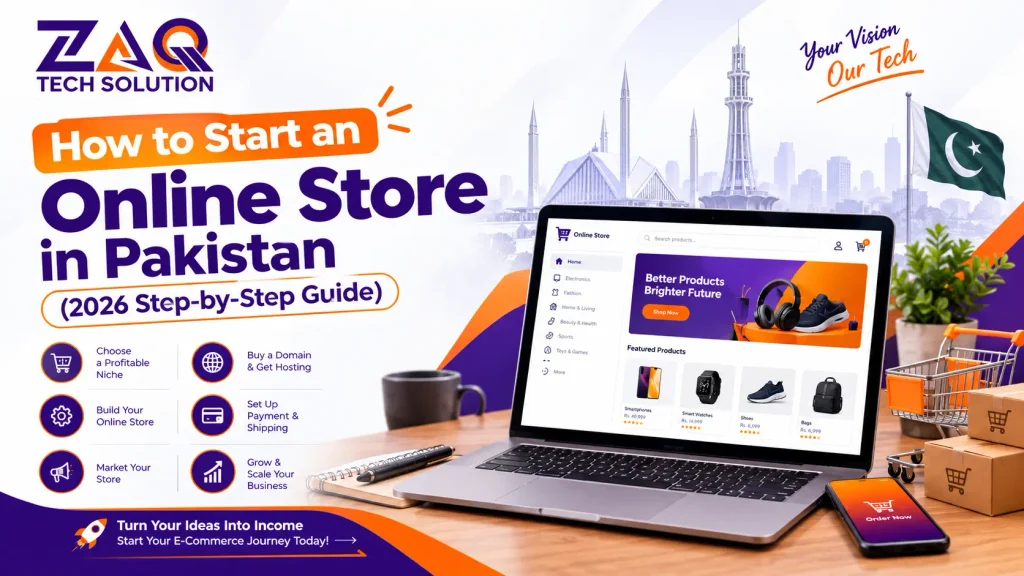
If you’ve been putting off launching your online store because it feels complicated — payment gateways, registration, choosing a platform — you’re not wrong, it can be.
But it doesn’t have to be. Thousands of Pakistani entrepreneurs launch stores every month, and most of the confusion comes from not knowing the right order of steps.
We promise this guide fixes that. By the end, you’ll have a clear, sequential roadmap — from niche research to your first sale.
Here’s what we’ll cover: picking a niche, choosing between Shopify, WooCommerce, Daraz, or a custom build, domain and hosting, JazzCash/EasyPaisa and COD setup, legal registration requirements, and a launch-ready SEO checklist.
This guide is written by ZAQ Tech, a Pakistan-based web and e-commerce development company that builds WooCommerce and custom online stores for local businesses.
Quick Answer (For Readers in a Hurry)
To start an online store in Pakistan, pick a profitable niche, choose a platform (WooCommerce or Shopify for most, custom-built for scale), register a .com.pk or .com domain, build the store, integrate JazzCash/EasyPaisa/COD payments, register your business with SECP or as a sole proprietorship, and launch with basic SEO in place. The full process typically takes 3–6 weeks.
What Does It Mean to “Start an Online Store”?
Starting an online store means setting up a digital storefront — on a platform like WooCommerce, Shopify, or a custom-built website — where customers can browse products, pay through local methods, and receive delivery, backed by a registered business entity.
It’s more than just “having a website.” A real launch includes four working parts:
- A platform that lists products and processes orders
- Payment methods customers in Pakistan actually trust (COD, JazzCash, EasyPaisa)
- Legal registration so you can operate and get paid properly
- Visibility — SEO and marketing so people can actually find you.
Why Start an Online Business in Pakistan in 2026
Pakistan’s e-commerce sector has grown steadily, with the State Bank of Pakistan and PACRA industry reports repeatedly noting double-digit year-over-year growth in e-commerce transaction volume over recent years, driven by mobile internet penetration and digital wallet adoption.
A few structural reasons 2026 is a good entry point:
- Mobile-first buyers — most traffic now comes from smartphones, not desktops
- Digital wallets are mainstream — JazzCash and EasyPaisa are now default payment expectations, not extras
- COD still dominates trust — but is increasingly paired with digital options rather than replacing them
- Lower barrier to entry — WooCommerce and Shopify have made store setup faster and cheaper than five years ago.
Don’t wait for the “perfect” niche. Launch with a focused product line, validate demand, then expand your catalog.
Step 1: Niche and Product Research
Before touching any platform, validate that people will actually buy what you’re selling.
How to Research a Profitable Niche
- Check Google Trends for Pakistan-specific search interest
- Study competitors already selling on Daraz, Instagram, and their own websites
- Look for a gap: better pricing, faster delivery, better quality, or an underserved city
- Validate demand with a small test — a landing page or Instagram post — before full investment.
Product-market fit matters more than platform choice at this stage — a well-validated niche on a basic store will outperform a perfect website with no demand.
Step 2: Choose Your E-commerce Platform
This is the decision most people get stuck on — and it shapes everything downstream.
Your Main Options
- WooCommerce (WordPress) — highly customizable, self-hosted, full ownership of your store and data
- Shopify — hosted, beginner-friendly, but monthly fees and limited local payment flexibility
- Daraz (marketplace) — fastest to list products, but no brand control and high commission
- Custom-built store — full control, built for scale, ideal once you outgrow templates.
For most Pakistani businesses selling directly to customers, WooCommerce is the most practical starting point — it integrates natively with local payment plugins, keeps hosting costs low, and gives you full ownership of your store, unlike marketplace listings or hosted platforms that limit customization.
If you’re unsure whether to go with a page-builder setup or a fully custom-coded store, our comparison of WordPress vs. custom HTML websites breaks down the trade-offs in more depth.
Step 3: Domain Registration
Your domain is your store’s permanent address — choose it carefully, since changing it later hurts SEO.
Domain Best Practices for Pakistan
- Prefer a .com for broader trust, or .com.pk if you want to signal a strictly local business
- Keep it short, brandable, and easy to type on a phone keyboard
- Avoid hyphens and numbers where possible
- Register through PKNIC (for .pk domains) or an accredited registrar for .com.
Buy matching social media handles at the same time you register your domain — brand consistency matters for trust signals later.
Step 4: Website Design and Development
This is where your store actually gets built — product pages, cart, checkout flow, and mobile responsiveness.
What a Well-Built Online Store Needs
- Mobile-first design — most Pakistani shoppers browse and buy on mobile
- Fast load times — slow product pages directly increase cart abandonment
- Clear product photography and descriptions
- Simple, minimal-click checkout
- Trust signals — return policy, contact number, WhatsApp chat.
If you’re building on WooCommerce, this typically means custom theme development plus plugin configuration for cart, checkout, and product filtering. For a full breakdown of what this costs by project type, see our guide on website development cost in Pakistan.
Need a development partner for this step? This is exactly where an e-commerce website development team handles design, plugin setup, and mobile optimization for you.
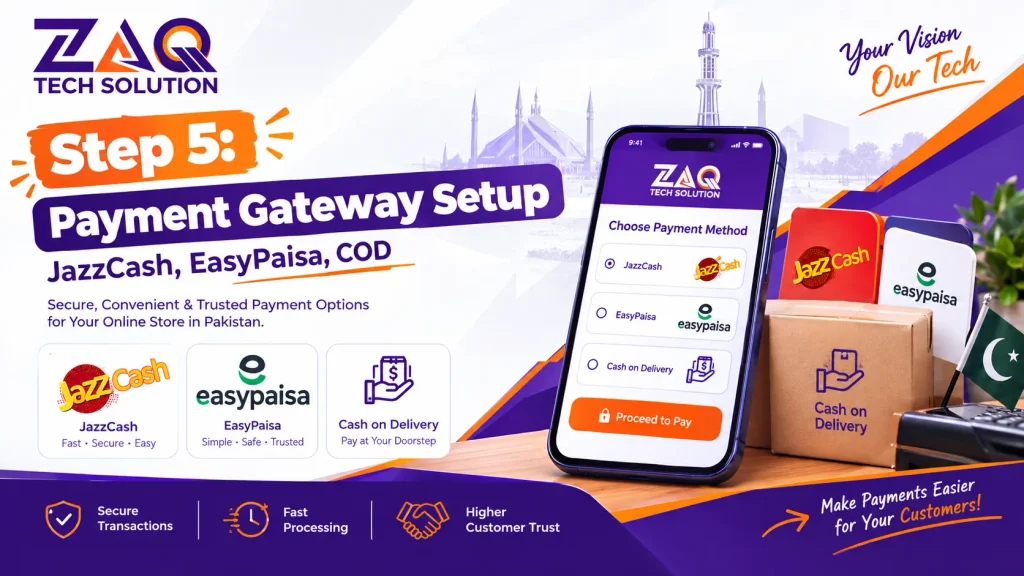
Step 5: Payment Gateway Setup — JazzCash, EasyPaisa, COD
Payment setup is where most first-time store owners in Pakistan get stuck — because global platforms weren’t built with local wallets in mind.
Why Local Payment Integration Matters
International platforms like Shopify don’t natively support JazzCash or EasyPaisa — you need third-party plugins or a custom integration to accept them. WooCommerce, by contrast, has direct plugin support for both.
Setting Up Each Payment Method
| Method | Setup Requirement | Why It Matters |
| Cash on Delivery (COD) | No integration needed, just a checkout option | Still the most trusted payment method for first-time online buyers in Pakistan |
| JazzCash | Merchant account + API/plugin integration | Wide reach via Jazz’s mobile wallet user base |
| EasyPaisa | Merchant account + API/plugin integration | Similarly wide mobile wallet reach via Telenor/Easypaisa users |
| Debit/Credit Card (via local gateway) | Bank merchant account or payment aggregator | Needed for higher-ticket or repeat B2B-style buyers |
To accept online payments in Pakistan, most stores combine at least three methods — COD for trust, and JazzCash plus EasyPaisa for digital wallet coverage — since relying on cards alone significantly limits your buyer base.
Even if you launch with COD only, integrate at least one digital wallet within your first month — it reduces delivery-day payment disputes and speeds up your cash flow.
Step 6: Legal and Business Registration Requirements
Selling online in Pakistan doesn’t legally require a large company structure to start — but formalizing early protects you.
Common Registration Paths
- Sole Proprietorship — simplest, register with FBR for an NTN (National Tax Number)
- Partnership — for two or more founders, registered under the Partnership Act
- Private Limited Company (SECP) — needed if you plan to raise investment, hire formally, or open a corporate bank account.
What You Typically Need
- NTN (National Tax Number) from FBR — required for most payment gateway merchant accounts
- Bank account in the business name — JazzCash/EasyPaisa merchant accounts usually require this
- Sales tax registration — only if turnover crosses the relevant provincial/federal threshold.
You don’t need to be a registered company to start selling on social media, but to get a JazzCash/EasyPaisa merchant account, a business bank account, or sell at scale, you’ll need at minimum an NTN and, in most cases, SECP registration.
Register your NTN before you approach a payment gateway — most merchant account applications ask for it upfront, and missing it is the most common launch delay.
Step 7: SEO and Marketing Launch
A store with no visibility doesn’t generate sales, no matter how well it’s built.
Pre-Launch SEO Checklist
- Optimize product titles and descriptions with real customer search terms
- Set up Google Business Profile if you have a physical presence
- Add schema markup for products (price, availability, reviews)
- Compress images for fast mobile load speed
- Set up Google Analytics and Meta Pixel before launch, not after.
Marketing Channels Worth Testing Early
- Instagram and Facebook ads — still the highest-ROI channels for Pakistani D2C brands
- WhatsApp Business — for order confirmations and customer support
- Influencer/micro-influencer collaborations — cost-effective for niche products
- SEO content — blog posts targeting buyer-intent keywords for long-term organic traffic.
If SEO and paid marketing aren’t your core strength, this is a good stage to bring in dedicated SEO services rather than treating it as an afterthought.
Best Platform to Start an Online Store in Pakistan: Comparison
Here’s an honest side-by-side, based on what actually matters for Pakistani sellers.
| Feature | WooCommerce | Shopify | Daraz (Marketplace) | Custom-Built |
| Ownership of store/data | Full | Partial (hosted) | None | Full |
| Local payment plugin support (JazzCash/EasyPaisa) | Native plugins available | Requires workaround/third-party apps | Handled by Daraz | Built to spec |
| Monthly cost | Hosting only (~$5–20/mo) | $25–65+/mo subscription | No listing fee, high commission per sale | Hosting only |
| Customization | High | Medium (template-based) | None | Complete |
| Learning curve | Medium | Low | Very low | N/A (built for you) |
| Best for | Brand-focused D2C stores wanting control | Beginners wanting a fast hosted setup | Testing product demand fast | High-scale or highly specific business logic |
WooCommerce is generally the best platform to start an online store in Pakistan for brand owners who want full control and native local payment integration, while Shopify suits beginners wanting a faster, hosted setup, and Daraz works best for quickly testing product demand without building a website.
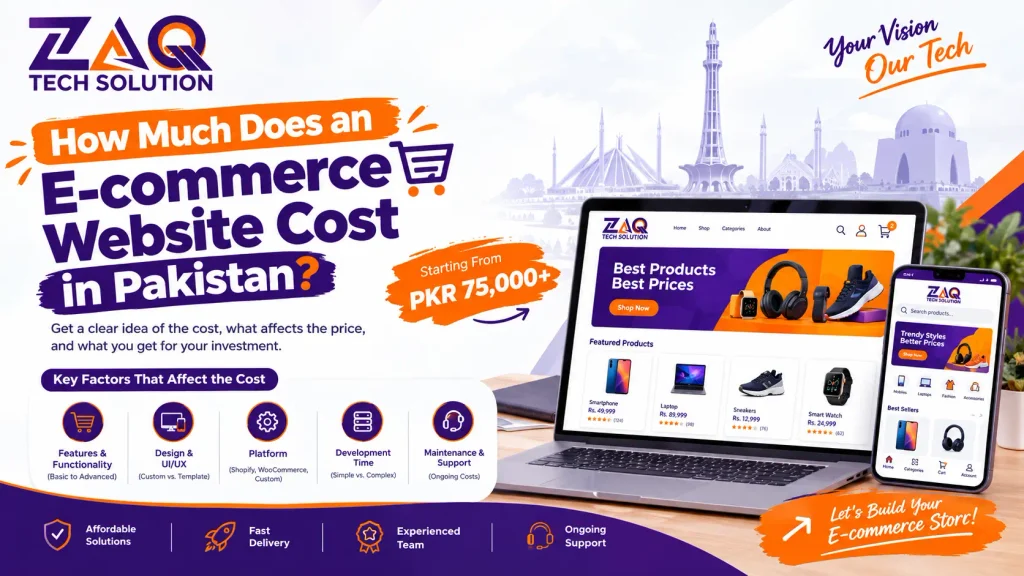
How Much Does an E-commerce Website Cost in Pakistan?
Costs vary widely depending on platform, design complexity, and integrations.
- Basic WooCommerce store (template-based): $400 – $1,200
- Custom-designed WooCommerce store: $1,500 – $5,000
- Shopify store setup (design + apps): $800 – $3,000 (plus ongoing subscription)
- Fully custom-built e-commerce platform: $5,000 – $25,000+
For a detailed, feature-by-feature cost breakdown, see our full guide on website development cost in Pakistan.
If you’re also evaluating vendors for this build, our guide on how to choose the right software development company in Pakistan walks through the exact evaluation checklist to use.
Common Mistakes to Avoid
- Launching without any digital payment option — COD-only stores lose customers who prefer wallets
- Skipping business registration — causes delays when applying for merchant accounts later
- Ignoring mobile page speed — most traffic is mobile, and slow load times kill conversions
- No returns/exchange policy visible — hurts trust, especially for first-time buyers
- Treating SEO as optional — organic traffic compounds over time and reduces ad dependency
- Choosing a platform based on hype, not fit — Shopify isn’t automatically “better” than WooCommerce for every business.
Why Businesses Choose ZAQ Tech for E-commerce Development
ZAQ Tech builds WooCommerce and custom e-commerce websites for businesses across Pakistan, with local payment integration built into the process from day one.
What this looks like in practice:
- WooCommerce and custom store development, matched to your actual business model
- JazzCash, EasyPaisa, and COD integration handled end-to-end
- Mobile-first design built for how Pakistani customers actually shop
- SEO-ready structure from launch, not bolted on later
- Transparent, milestone-based pricing — no hidden costs.
If you’re ready to move from planning to building, this is the exact process we walk clients through.
FAQs
Q1: How do I start an online store in Pakistan?
A: Start by researching your niche, choosing a platform (WooCommerce is recommended for most), registering a domain, building the store, integrating JazzCash/EasyPaisa/COD, registering your business with FBR/SECP, and launching with basic SEO in place.
Q2: Which is better — Shopify or WooCommerce for Pakistan?
A: WooCommerce is generally better for Pakistani sellers because it offers native local payment gateway support, lower ongoing costs, and full store ownership, while Shopify suits beginners who want a faster hosted setup and don’t mind monthly subscription fees.
Q3: Do I need to register my business to sell online in Pakistan?
A: You can start selling informally on social media without registration, but to get a JazzCash/EasyPaisa merchant account, open a business bank account, or scale legally, you’ll need at least an NTN from FBR and, in most cases, SECP registration.
Q4: How do I accept JazzCash and EasyPaisa payments on my website?
A: You accept JazzCash and EasyPaisa by applying for a merchant account with each provider, then integrating their official plugin or API into your website’s checkout — WooCommerce supports both natively through plugins.
Q5: Is Cash on Delivery still necessary for online stores in Pakistan?
A: Yes — COD remains one of the most trusted payment methods for first-time online buyers in Pakistan, and most successful stores offer it alongside digital wallets rather than replacing it entirely.
Q6: How much does it cost to build an online store in Pakistan?
A: A basic WooCommerce store costs roughly $400–$1,200, a custom-designed store ranges from $1,500–$5,000, and a fully custom-built e-commerce platform can range from $5,000–$25,000+, depending on features and integrations.
Q7: How long does it take to launch an online store?
A: A basic WooCommerce store can launch in 2–3 weeks, while a custom-designed store with full payment integration and legal registration typically takes 4–6 weeks.
Q8: What documents do I need to register an online business in Pakistan?
A: You’ll typically need a CNIC, an NTN from FBR, and — if registering as a private limited company — SECP incorporation documents, a memorandum of association, and a registered business address.
Pingback: WooCommerce vs Shopify for Pakistani E-commerce (2026)