If you’ve ever asked “why isn’t my website ranking on Google,” you’ve probably run into these three terms and felt a little lost.
You’re not alone. Most business owners we talk to at ZAQ Tech — whether they’re running a shop in Rawalpindi or a growing e-commerce store in Karachi — mix these three up at some point.
Here’s the promise: by the end of this guide, you’ll know exactly what on-page SEO, technical SEO, and off-page SEO mean, how they’re different, and how they work together to get a website ranking. We’ll also hand you a practical checklist you can start using today.
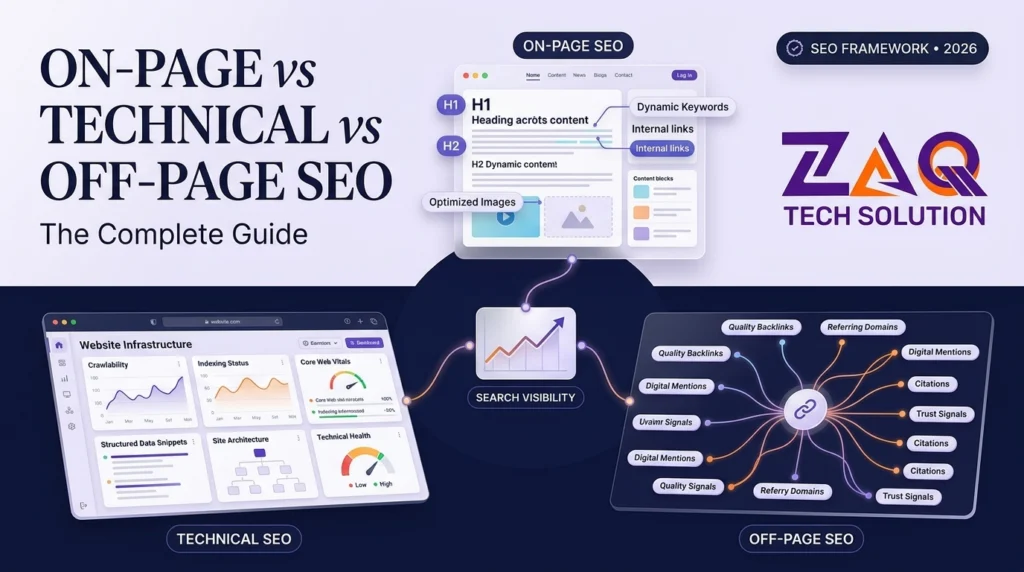
On-page SEO optimizes the content and HTML elements on your own pages (titles, headings, keywords). Technical SEO optimizes how search engines crawl, index, and render your site (speed, mobile-friendliness, structure). Off-page SEO builds authority and trust from outside your website, mainly through backlinks and brand mentions. All three pillars have to work together — a website is only as strong as its weakest pillar.
What Is SEO and Why Does It Have Three Pillars?
Search Engine Optimization (SEO) is the practice of improving a website so it ranks higher in organic (unpaid) search results.
Think of your website as a physical shop.
- On-page SEO is how the shop looks inside — clean shelves, clear signage, easy-to-read price tags.
- Technical SEO is the building itself — the foundation, doors, wiring, and whether customers can even walk in without tripping.
- Off-page SEO is your shop’s reputation in the neighborhood — word of mouth, reviews, and other trusted shops recommending you.
Google (and increasingly AI search engines like ChatGPT, Gemini, Perplexity, and Claude) evaluate all three before deciding whether your website deserves a top spot.
A study by Backlinko found that <cite index=”19-1″>the average first-page result on Google contains around 1,447 words</cite>, which shows why on-page content depth matters — but content alone won’t rank if your site is technically broken or has zero external trust signals.
What Is On-Page SEO?
On-page SEO (also called “on-site SEO”) refers to all the optimizations you make directly on your website’s pages to help search engines and users understand your content.
Core On-Page SEO Elements
- Title tags – The clickable headline in search results. Keep it under 60 characters.
- Meta descriptions – The short summary under your title. Aim for 150–160 characters.
- Header tags (H1–H4) – Organize content logically so both users and search engines can scan it.
- Keyword placement – Using your primary and secondary keywords naturally in the first 100 words, headings, and body text.
- Content quality and depth – Answering the searcher’s question thoroughly and accurately.
- Internal linking – Connecting related pages on your own site.
- Image optimization – Alt text, compressed file sizes, descriptive filenames.
- URL structure – Short, readable, keyword-rich slugs.
Why On-Page SEO Matters
On-page SEO is where you have the most direct control. You decide the words, structure, and clarity of every page.
Good on-page SEO also feeds AI search engines. Tools like ChatGPT and Perplexity pull direct, well-structured answers from pages that clearly define terms and answer questions in the first few lines — which is exactly why this section leads with a straight definition.
What Is Technical SEO?
Technical SEO covers the behind-the-scenes work that helps search engines crawl, index, and render your website correctly — and helps visitors actually use it without frustration.
Core Technical SEO Elements
- Site speed – Faster-loading pages rank better and convert more visitors.
- Mobile-friendliness – Google uses mobile-first indexing, meaning your mobile site version is what gets evaluated first.
- Crawlability and indexability – Making sure search engines can find and read all your important pages (robots.txt, XML sitemaps).
- Site architecture – A logical, shallow structure so no page is more than a few clicks from the homepage.
- HTTPS/SSL security – A secure connection is a confirmed ranking factor.
- Structured data (schema markup) – Helps search engines understand context and enables rich results like FAQ snippets.
- Core Web Vitals – Google’s metrics for loading speed, interactivity, and visual stability.
- Canonical tags and duplicate content control – Preventing confusion when similar content exists on multiple URLs.
Why Technical SEO Matters
You can write the best content in the world, but if your site takes eight seconds to load or search engines can’t crawl it, none of that content gets seen.
Google has publicly confirmed that Core Web Vitals are part of its page experience ranking signals, which is why speed and stability aren’t optional extras anymore — they’re foundational.
What Is Off-Page SEO (Link Building)?
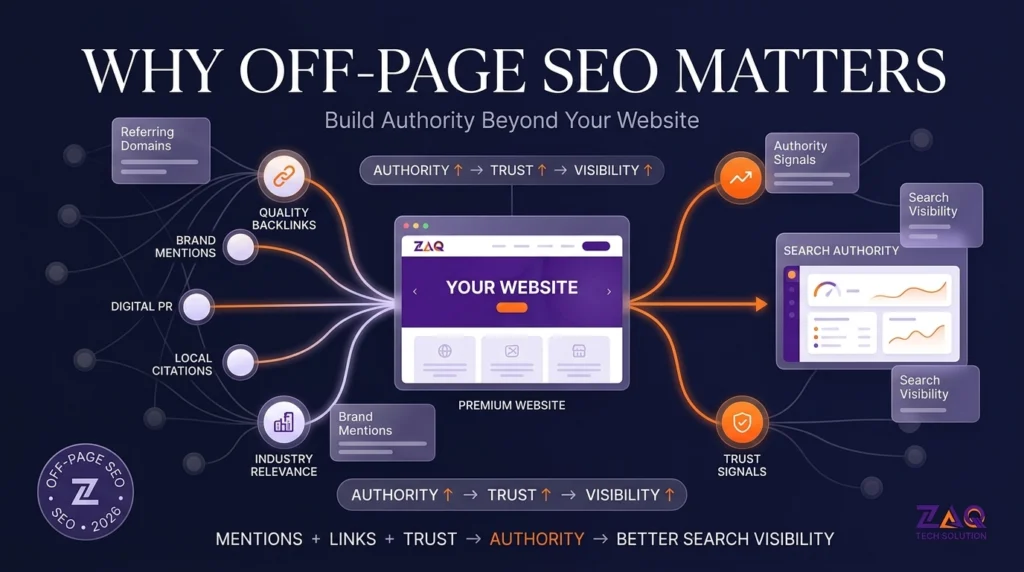
Off-page SEO includes all the actions taken outside your own website to improve its authority, trustworthiness, and reputation in the eyes of search engines.
Core Off-Page SEO Elements
- Backlinks – Links from other reputable websites pointing to yours. Still one of the strongest ranking signals.
- Brand mentions – Being talked about online, even without a direct link, builds entity trust.
- Guest posting – Contributing content to authoritative sites in your industry with a natural link back.
- Local citations – Consistent business listings (Name, Address, Phone) across directories like Google Business Profile.
- Social signals – Shares, engagement, and visibility on social platforms.
- Digital PR – Getting featured in news outlets, industry blogs, or podcasts.
- Reviews and reputation management – Positive reviews on Google, Facebook, and industry-specific platforms.
Why Off-Page SEO Matters
Search engines treat backlinks and mentions as “votes of confidence.” A site with strong content and technical health but zero external trust signals will still struggle to outrank established competitors.
This is exactly why our <cite index=”7-1″>SEO audit process in Islamabad tracks external factors such as backlinks, anchor texts, and domain references recognized by search engines</cite> — off-page signals are treated as seriously as on-page content.
On-Page vs Technical vs Off-Page SEO: The Key Differences
| SEO Type | Focus Area | Where It Happens | Key Tasks | Example |
| On-Page SEO | Content & relevance | Directly on your web pages | Title tags, headings, keywords, content quality, internal links | Rewriting a blog title and adding proper H2/H3 structure |
| Technical SEO | Crawlability & performance | Site infrastructure & code | Speed optimization, mobile-friendliness, sitemap, schema markup | Compressing images to cut page load time from 6s to 2s |
| Off-Page SEO | Authority & trust | Outside your website | Backlinks, guest posts, citations, reviews, PR | Getting a backlink from a respected local news site |
Quick Comparison Snapshot
- On-page SEO answers: “Is this page relevant and well-written for the search query?”
- Technical SEO answers: “Can search engines and users actually access and use this page?”
- Off-page SEO answers: “Do other trusted sources vouch for this website?”
All three pillars are interdependent. A technically flawless site with thin content won’t rank. A content-rich site with no backlinks will struggle to compete. And a well-linked site that’s slow and broken will frustrate visitors and search engines alike.
Complete SEO Checklist: On-Page, Technical, and Off-Page
On-Page SEO Checklist
- Primary keyword in the title tag, URL, and first 100 words
- Meta description written for click-through, not just keyword stuffing
- One clear H1, logical H2/H3/H4 hierarchy
- Content thoroughly answers the search intent
- Internal links to relevant pages
- Alt text on all images
- Readable formatting: short paragraphs, bullet points, tables.
Technical SEO Checklist
- Site loads in under 3 seconds
- Mobile-responsive design confirmed on real devices
- XML sitemap submitted to Google Search Console
- Robots.txt file configured correctly
- HTTPS enabled sitewide
- No broken links or 404 errors
- Schema markup added for FAQs, articles, and local business.
Off-Page SEO Checklist
- Backlinks from relevant, reputable websites
- Google Business Profile fully completed and verified
- Consistent NAP (Name, Address, Phone) across directories
- Active social media presence with regular engagement
- Ongoing review generation and reputation monitoring
- Guest posting or digital PR outreach.
Which One Should You Focus On First?
If your website is brand new or has never been audited, this is the practical order most SEO professionals recommend:
- Start with technical SEO. Fix crawl errors, speed issues, and mobile problems first — otherwise your other efforts get wasted.
- Move to on-page SEO. Optimize existing pages and publish content that directly answers your audience’s questions.
- Layer in off-page SEO. Once your site is fast, crawlable, and content-rich, start building the external trust signals that push you past competitors.
For most small and medium businesses in Pakistan, this order avoids the common mistake of chasing backlinks for a site that Google can’t even properly crawl.
Cost of SEO in Pakistan: What Affects the Price
SEO pricing in Pakistan varies widely depending on competition level, industry, and scope of work. A few factors that typically move the price:
- Website size – A 10-page site costs less to optimize than a 500-product e-commerce store.
- Competition – Ranking for “cafe in Rawalpindi” is far cheaper than ranking for “best software house in Pakistan.”
- Scope – A one-time technical audit costs less than an ongoing monthly on-page, technical, and off-page campaign.
- Local vs national vs international targeting – Local SEO campaigns are generally more affordable than campaigns targeting multiple cities or countries.
If you want a clear, itemized breakdown, ZAQ Tech’s SEO packages outline exactly what’s included at each pricing tier, so there are no surprise costs later.
SEO Fundamentals for Beginners
If you’re just starting out, here are the non-negotiables:
- Understand search intent first. Know whether users want information, a comparison, or to buy something — then match your content to that intent.
- Never sacrifice user experience for keywords. Keyword stuffing hurts rankings and drives visitors away.
- Track everything. Use Google Search Console and Analytics to see what’s actually working.
- SEO is a long game. Most reputable results take 3–6 months to show meaningfully, not days.
- Local businesses need local SEO. Google Business Profile optimization and local citations matter as much as your website itself.
Expert Tips from ZAQ Tech
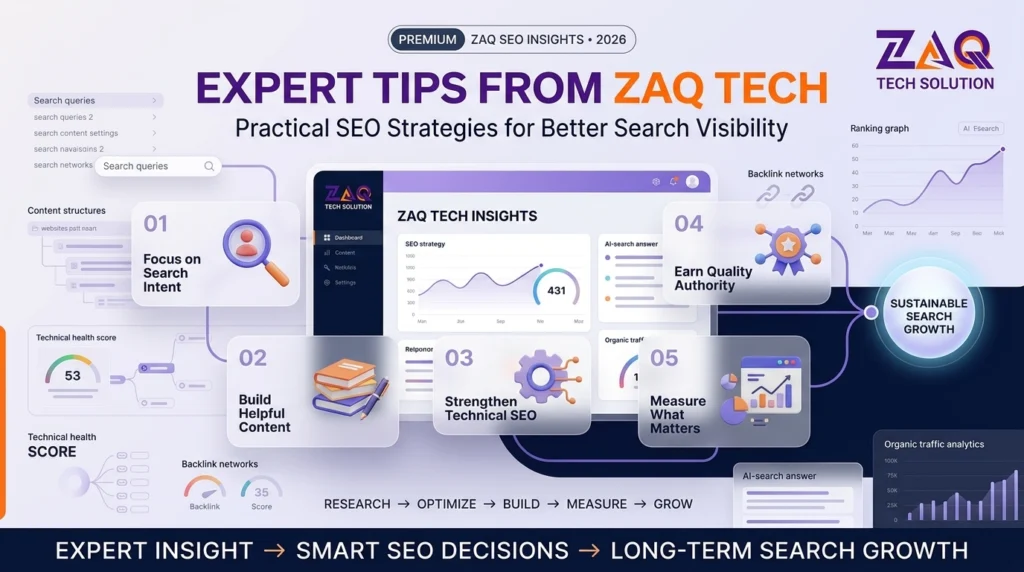
- Audit before you optimize. You can’t fix what you haven’t measured — start every project with a full technical, on-page, and backlink audit.
- Prioritize Core Web Vitals early. Page experience signals are only becoming more important, not less.
- Build links naturally, not in bulk. A handful of relevant, authoritative backlinks outperforms hundreds of low-quality ones.
- Write for AI search too. Structure your content with clear definitions and direct answers so AI engines like ChatGPT and Perplexity can cite you.
- Don’t neglect local signals. For Pakistani businesses, local SEO — citations, Google reviews, and location-specific content — often delivers faster ROI than broad national campaigns.
Our team has applied this exact framework across SEO services in Pakistan, including city-specific campaigns for SEO services in Islamabad, SEO services in Lahore, SEO services in Karachi, and SEO services in Rawalpindi.
If you’re comparing agencies, our guide on the best SEO company in Pakistan breaks down exactly what to look for before you commit to a contract.
FAQs
Q1: What is the difference between on-page SEO and technical SEO?
A: On-page SEO focuses on content and keyword relevance within a page (titles, headings, text). Technical SEO focuses on the site’s infrastructure — speed, crawlability, mobile-friendliness, and code health.
Q2: Which is more important: on-page, technical, or off-page SEO?
A: None works well alone. Technical SEO makes your site accessible, on-page SEO makes it relevant, and off-page SEO makes it trusted. A strong strategy needs all three.
Q3: What are the three pillars of SEO?
A: The three pillars are on-page SEO (content and structure), technical SEO (site performance and crawlability), and off-page SEO (external authority through backlinks and mentions).
Q4: Is off-page SEO just link building?
A: Link building is the biggest part of off-page SEO, but it also includes brand mentions, local citations, reviews, social signals, and digital PR.
Q5: How long does SEO take to show results?
A: Most businesses see measurable movement within 3–6 months, though highly competitive industries can take longer. SEO compounds over time rather than delivering instant results.
Q6: How much does SEO cost in Pakistan?
A: Costs vary based on website size, competition, and campaign scope. Check ZAQ Tech’s SEO packages for transparent, tiered pricing.
Q7: Can I do SEO myself, or do I need an agency?
A: Basic on-page SEO is manageable for beginners. Technical SEO and scalable, ethical off-page link building typically benefit from professional expertise, especially for competitive industries.
Conclusion
On-page SEO, technical SEO, and off-page SEO aren’t competing strategies — they’re three parts of the same machine.
Skip one, and the other two work harder for smaller results. Get all three right, and you build a website that ranks, converts, and holds its position over time.
If you’d rather have professionals handle the audit, strategy, and execution, ZAQ Tech’s SEO services in Pakistan cover all three pillars under one transparent plan — explore our packages to find the right fit for your business.
Pingback: Google Business Profile Optimization Pakistan | Rank on Maps