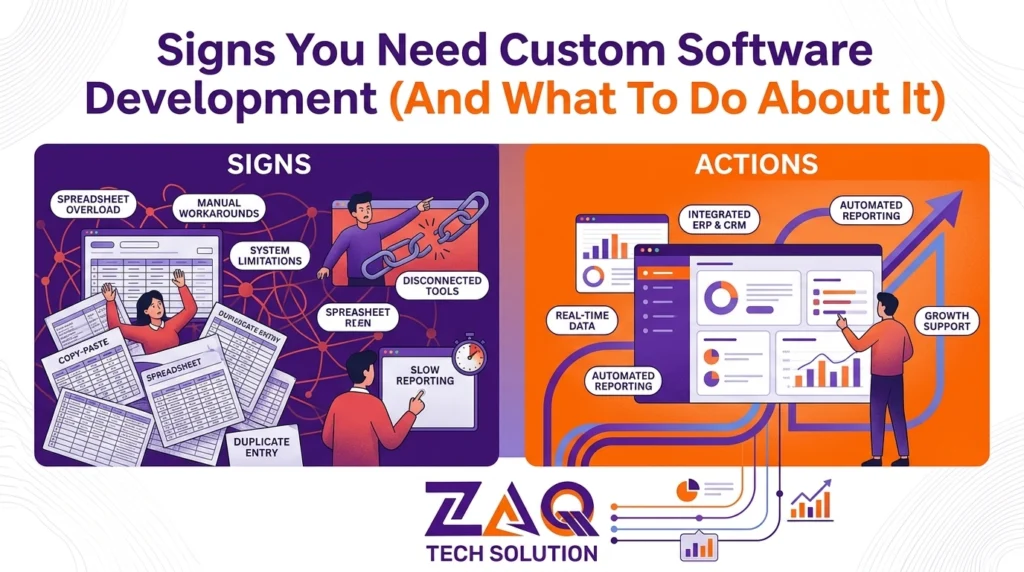
If your team is drowning in spreadsheets, copy-pasting data between five different tools, or waiting three days for a report that should take three minutes — you’re not alone, and you’re not imagining it.
Most growing businesses hit this exact wall. The tools that got you to where you are today are the same tools quietly holding you back from where you want to go next.
Here’s the good news: you don’t need to overhaul everything overnight. You need to recognize the signs early, understand your real options, and make a decision that actually fits your business — not just whatever software happened to be popular when you started.
This guide walks through the clearest signs your business needs custom software development, how custom ERP and CRM systems differ from off-the-shelf tools, and exactly when it makes sense to make the switch.
In short: you need custom software development when off-the-shelf tools force your team to work around the software instead of the software working for your team — usually shown through duplicate data entry, disconnected spreadsheets, slow reporting, manual workarounds, and growth that your current systems simply can’t support.
What Is Custom Software Development?
Custom software development is the process of designing, building, and maintaining software created specifically for one business’s workflows, instead of using a generic, mass-market product built for thousands of different companies at once.
Think of it like the difference between a rented suit and one that’s tailored to you. Off-the-shelf software fits reasonably well. Custom software fits exactly.
Common examples include:
- Custom ERP (Enterprise Resource Planning) systems
- Custom CRM (Customer Relationship Management) platforms
- Business automation tools and internal dashboards
- Customer portals and admin panels
- Industry-specific management systems (logistics, healthcare, retail, education)
At ZAQ Tech, this is one of our core service areas — you can see how we approach it on our Software Development Company in Pakistan page.
Custom Software vs Off-the-Shelf: The Real Difference
This is the first fork in the road for most businesses, and it’s worth understanding clearly before you spend money either way.
We’ve also written a deeper breakdown in our guide on custom software vs off-the-shelf software, but here’s the quick version.
| Factor | Off-the-Shelf Software | Custom Software |
| Initial cost | Lower upfront | Higher upfront |
| Long-term cost | Recurring fees add up over years | One-time build, lower long-term cost |
| Fit to your process | You adjust your workflow to the tool | The tool is built around your workflow |
| Scalability | Often capped by license tiers | Grows with your business |
| Integrations | Limited to what the vendor supports | Built to connect with anything you need |
| Ownership | You rent access | You own the system |
| Time to launch | Immediate | Weeks to months, depending on scope |
| Competitive edge | Same tool as your competitors | Built around what makes you different |
Neither option is universally “better.” A five-person startup testing an idea rarely needs custom ERP software development on day one. But a business that’s outgrown its tools, or one whose processes are genuinely unique, usually finds off-the-shelf software becomes the more expensive option over time — just in hidden costs.
Don’t ask “which is cheaper?” Ask “which one will still fit my business in three years?” That single question saves most companies from an expensive mistake.
7 Clear Signs You Need Custom Software Development
Here are the patterns we see most often when a business reaches out to us for custom software.
1. You’re managing data across disconnected spreadsheets
If your sales numbers live in one spreadsheet, your inventory in another, and your customer list in a third, you’re not running a system — you’re running a patchwork.
Every disconnected file is a place where errors creep in and time gets wasted.
How ZAQ Tech fixes this: We consolidate scattered spreadsheets into a single custom ERP or CRM software for small business, with one source of truth for every department.
2. Your team duplicates work across multiple tools
When someone enters an order in your accounting tool, then re-enters it in your CRM, then again in a shipping spreadsheet — that’s three chances for a mistake and three times the labor.
How ZAQ Tech fixes this: We build integrated systems where data is entered once and flows automatically wherever it’s needed.
3. Reporting takes days instead of minutes
If getting a simple sales report means someone manually pulling numbers from four places and building a chart by hand, your reporting process is actively costing you decisions.
How ZAQ Tech fixes this: Custom dashboards give you real-time, accurate reporting — no manual compiling required.
4. Off-the-shelf software forces you to change how you work
Good software should adapt to your business. If you’re constantly working around a tool’s limitations — skipping steps, using workarounds, or maintaining a “shadow process” outside the software — the tool isn’t serving you anymore.
How ZAQ Tech fixes this: We design systems around your actual workflow, not the other way around.
5. You’re paying for features you don’t use — and missing ones you need
Many off-the-shelf platforms bundle dozens of features into expensive tiers, most of which sit unused, while the one feature you actually need is locked behind an even higher plan.
How ZAQ Tech fixes this: Business automation software solutions built custom mean you only pay for what your business actually needs — nothing more, nothing less.
6. Your business processes are genuinely unique
If your operations involve a workflow, compliance requirement, or industry-specific process that no generic tool handles well, that’s a strong signal.
How ZAQ Tech fixes this: We’ve built systems across healthcare, fintech, logistics, education, and e-commerce, adapting to sector-specific rules and regulations.
7. You’re scaling fast and your current tools can’t keep up
Growth is a good problem — until your software starts breaking under it. Slow load times, license limits, or systems that simply weren’t built for your current transaction volume are all warning signs.
How ZAQ Tech fixes this: Custom software is architected to scale with you, so growth doesn’t mean starting over again in two years.
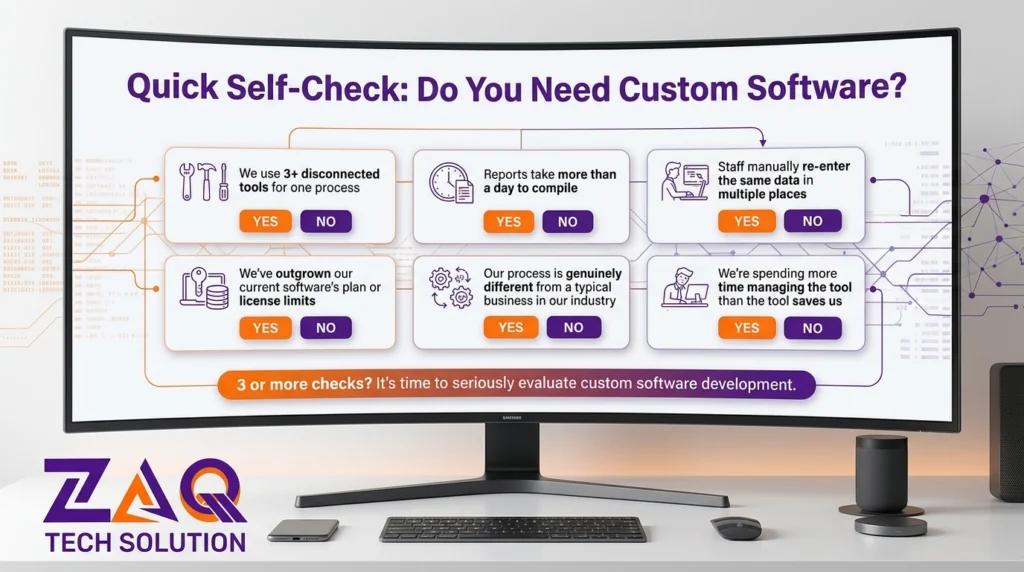
Quick Self-Check: Do You Need Custom Software?
Answer yes or no:
- We use 3+ disconnected tools for one process
- Reports take more than a day to compile
- Staff manually re-enter the same data in multiple places
- We’ve outgrown our current software’s plan or license limits
- Our process is genuinely different from a typical business in our industry
- We’re spending more time managing the tool than the tool saves us.
3 or more checks? It’s time to seriously evaluate custom software development.
When to Switch From Spreadsheets to ERP
Spreadsheets are a great starting point. They’re flexible, free, and familiar. But they were never designed to run an entire business.
You should switch from spreadsheets to ERP when your spreadsheets start requiring more manual maintenance than actual decision-making.
Specific triggers include:
- Multiple people editing the same file — leading to version conflicts and overwritten data.
- Formulas breaking silently — errors that go unnoticed until a report looks “off.”
- No real-time visibility — everyone works from a file that’s already outdated by the time it’s shared.
- Inventory or finance mismatches — spreadsheets that don’t sync with what’s actually happening on the ground.
- Growth beyond a single team — spreadsheets work for one department; they collapse across five.
A short industry stat worth noting: businesses that continue relying on manual spreadsheet-based operations past a certain size typically report significantly higher data-entry error rates than those using integrated ERP systems, simply because manual re-entry multiplies the chance of human error at every step.
If any two of the triggers above sound familiar, it’s a sign your business has already outgrown spreadsheets — even if it doesn’t feel that way yet.
Custom ERP vs Custom CRM: What’s the Difference?
These two terms get used interchangeably, but they solve different problems.
| Custom ERP Software | Custom CRM Software | |
| Core purpose | Runs internal operations (inventory, finance, HR, production) | Manages customer relationships and sales pipeline |
| Primary users | Operations, finance, and admin teams | Sales, marketing, and support teams |
| Main benefit | Operational efficiency and accurate internal data | Better customer retention and sales visibility |
| Best for | Businesses managing inventory, finance, or multi-department operations | Businesses focused on lead tracking and customer communication |
Many businesses eventually need both, connected to each other — so a sale recorded in the CRM automatically updates inventory and finance in the ERP, without anyone touching a spreadsheet.
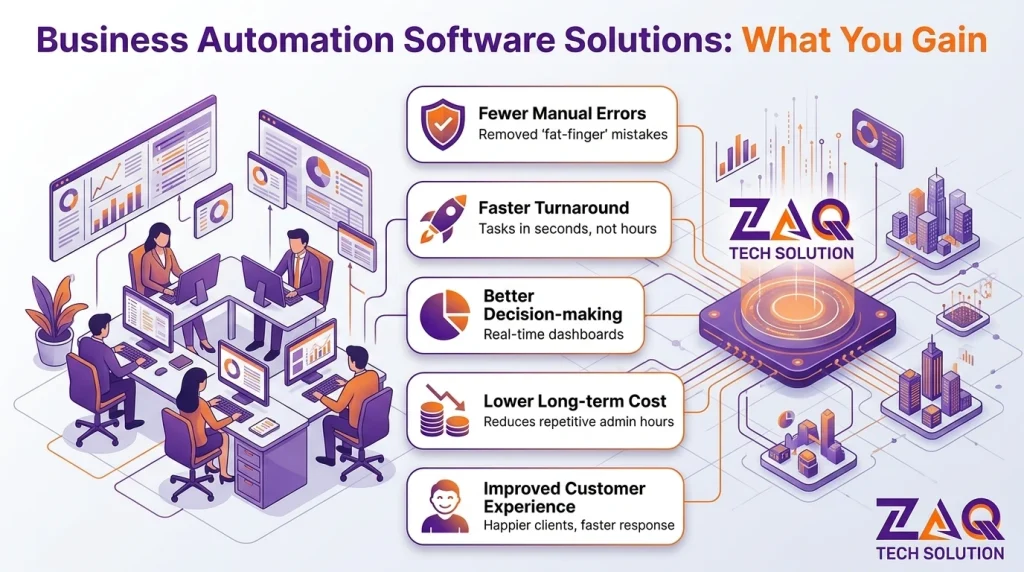
Business Automation Software Solutions: What You Gain
Custom automation isn’t about replacing people — it’s about removing repetitive, error-prone tasks so your team can focus on work that actually needs a human.
Key benefits of business automation software:
- Fewer manual errors — automated data entry removes the “fat-finger” mistakes that come from re-typing information.
- Faster turnaround — tasks that took hours (invoicing, reporting, order processing) can happen in seconds.
- Better decision-making — real-time dashboards replace outdated weekly reports.
- Lower long-term cost — automation reduces the staff hours spent on repetitive admin work.
- Improved customer experience — faster response times and fewer errors mean happier clients.
How Much Does Custom Software Development Cost?
There’s no single number here — cost depends on scope, integrations, and complexity — but businesses evaluating custom software should think in terms of total value, not just sticker price.
Factors that affect cost:
- Number of user roles and permission levels
- Integrations with existing tools (accounting, payment gateways, CRMs)
- Whether it’s web-based, mobile, or both
- Data migration from old spreadsheets or legacy systems
- Ongoing support and maintenance needs.
Ask any development partner for a phased quote — an MVP (minimum viable product) first, then expanded features. This keeps costs predictable and lets you validate the system before scaling it further.
Best Practices Before You Start a Custom Software Project
- Map your current workflow first. Don’t jump to features — understand exactly what’s broken today.
- Involve the people who’ll actually use it. The best software requirements come from the staff doing the work, not just management.
- Prioritize integrations early. A system that doesn’t talk to your existing accounting or payment tools creates new silos instead of removing them.
- Plan for scale from day one. Build architecture that can handle 10x your current volume, not just today’s.
- Choose a partner with real industry experience, not just technical skill — process understanding matters as much as code quality.
Why Work With a Custom Software Development Company in Pakistan
Pakistan has become a strong hub for custom software development, offering experienced development talent at a significantly more competitive cost than Western markets, without compromising on quality or communication.
ZAQ Tech has been delivering web, mobile, and custom software solutions since 2017, working across healthcare, fintech, logistics, education, and e-commerce. Our approach starts with listening — we study your actual workflow before writing a single line of code, then build systems that are secure, scalable, and easy to maintain long after launch.
We also support businesses beyond development — including Google Business Profile Optimization Pakistan and full-funnel digital growth, backed by our approach to On-Page SEO vs Technical SEO vs Off-Page SEO, so your new system doesn’t just work well internally — it supports your visibility and growth externally too.
If you’re weighing whether custom software makes sense for your business, our team offers a free initial consultation to map out what a tailored ERP, CRM, or automation system could look like for you.
FAQs
Q1: What are the main signs a business needs custom software development?
A: The clearest signs are disconnected spreadsheets, duplicate data entry across tools, slow manual reporting, unique processes that generic software can’t handle, and growth that current systems can’t support.
Q2: Is custom software more expensive than off-the-shelf software?
A: Custom software typically has a higher upfront cost but lower long-term cost, since there are no recurring license fees and it’s built to scale without needing to be replaced later.
Q3: Can custom software integrate with my existing CRM or ERP?
A: Yes. Custom software is specifically designed to integrate with your existing tools — including accounting platforms, payment gateways, and current CRM or ERP systems — through APIs built for that purpose.
Q4: How long does custom software development take?
A: Timelines vary by scope, but a typical MVP (minimum viable product) can launch in 8–16 weeks, with additional features rolled out in phases afterward.
Q5: What’s the difference between ERP and CRM software?
A: ERP software manages internal operations like inventory, finance, and HR, while CRM software manages customer relationships, sales pipelines, and communication. Many businesses eventually connect both systems.
Q6: When should a small business build custom CRM software instead of using a generic one?
A: When sales processes are unique, when generic CRM fields don’t match your actual sales stages, or when you need tighter integration with inventory or finance data that off-the-shelf CRMs don’t support well.
Q7: Do I need custom software if I’m still a small business?
A: Not always. If a generic tool fully covers your workflow and you’re not hitting scaling issues, off-the-shelf software may still be the right call. Custom software becomes worthwhile once workarounds start costing more time than they save.
Considering custom software for your business? Talk to ZAQ Tech about building a system tailored to how your team actually works.
Pingback: Website Development Cost in Pakistan (2026 Guide)