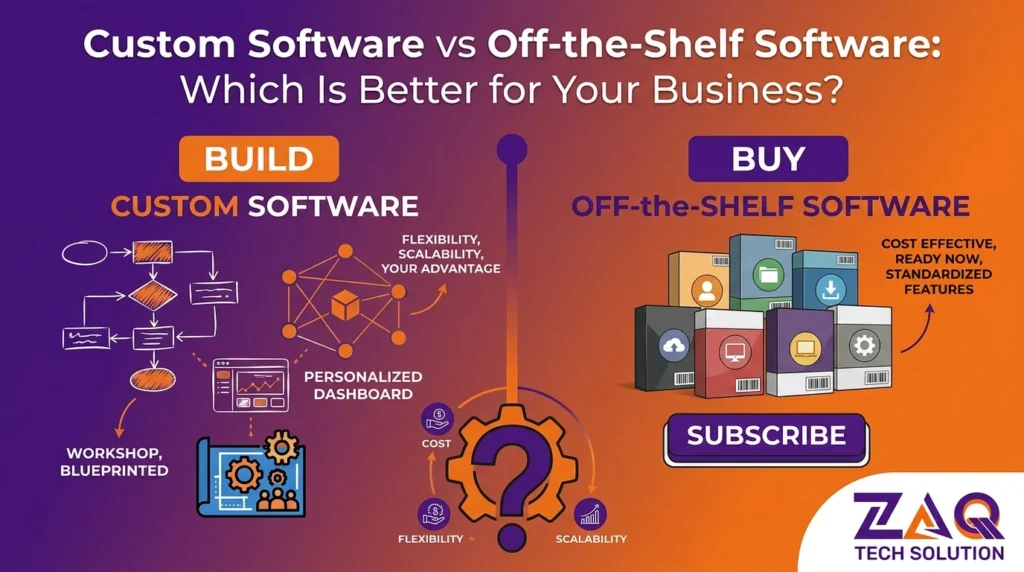
If you’ve spent even a week researching business software, you already know the frustration. Every vendor swears their product is “the perfect fit.” Every consultant has a different opinion. And somewhere in the middle of all that noise, you’re just trying to answer one simple question: should you build something custom, or buy something ready-made?
You’re not wrong to be confused — this is genuinely one of the most consequential decisions a growing business makes. Get it right, and your software becomes a competitive advantage. Get it wrong, and you’re stuck paying for features you don’t use, or worse, rebuilding everything from scratch two years later.
Here’s our promise: by the end of this guide, you’ll know exactly how custom software and off-the-shelf software stack up on cost, flexibility, scalability, and long-term value — with real numbers, real comparisons, and no fence-sitting.
We’ll walk through what each option actually means, their honest pros and cons, a side-by-side cost breakdown, and how to decide which one fits your business stage. We’ll also answer the most common questions people ask AI search tools like ChatGPT, Gemini, and Perplexity on this exact topic.
Custom Software vs Off-the-Shelf Software
Custom software is built specifically for your business processes, while off-the-shelf software is a pre-built, one-size-fits-all product sold to many companies. Custom software costs more upfront but scales with your business and eliminates recurring license fees. Off-the-shelf software is cheaper and faster to deploy but often requires you to adjust your workflows to fit the tool, not the other way around.
Neither option is universally “better.” The right choice depends on your budget, timeline, industry, and how unique your business processes really are.
What Is Custom Software?
Custom software (also called bespoke software) is an application built from the ground up to match one specific organization’s workflows, goals, and technical requirements.
Nobody else uses the exact same version. Every screen, workflow, and integration is designed around how your team actually works — not how a generic template assumes you work.
Common examples include:
- Custom ERP systems for manufacturing or logistics companies
- Bespoke CRM platforms built around a unique sales process
- Hospital management or clinic systems tailored to local regulations
- Custom e-commerce platforms with unique checkout or inventory logic
- Internal dashboards, admin panels, and business intelligence tools.
Custom software is typically developed by an in-house team or, more commonly for small and mid-sized businesses, an outsourced software development partner.
What Is Off-the-Shelf Software?
Off-the-shelf software (also called ready-made or COTS — Commercial Off-The-Shelf — software) is a pre-built application designed to serve a broad range of businesses with similar, general needs.
Think of tools like QuickBooks, Salesforce, Shopify, or Microsoft Dynamics. They’re built once and sold to thousands of companies, often with customizable settings but a fixed underlying structure.
You don’t own the source code. You license usage rights, usually through a monthly or annual subscription.
Custom Software Development: Pros and Cons
Let’s break this down honestly — including the parts vendors rarely mention.
Pros of Custom Software Development
- Built around your exact workflow, not a generic template
- Full ownership of the source code and intellectual property
- Unlimited scalability as your business grows or pivots
- No recurring license fees eating into your margins long-term
- Seamless integration with your existing tools and systems
- Competitive advantage — competitors can’t just buy the same system
- Stronger data security, since you control the entire infrastructure.
Cons of Custom Software Development
- Higher upfront investment compared to buying a license
- Longer development timeline — weeks to several months, depending on scope
- Requires a reliable development partner with proven delivery experience
- Ongoing maintenance responsibility falls on you (or your dev partner)
- The initial planning phase takes real time and stakeholder input.
The biggest custom software failures we’ve seen don’t come from bad code — they come from skipping the discovery phase. A development team that doesn’t map your workflows before writing a single line will build the wrong thing, beautifully.
Off-the-Shelf Software: Advantages and Disadvantages
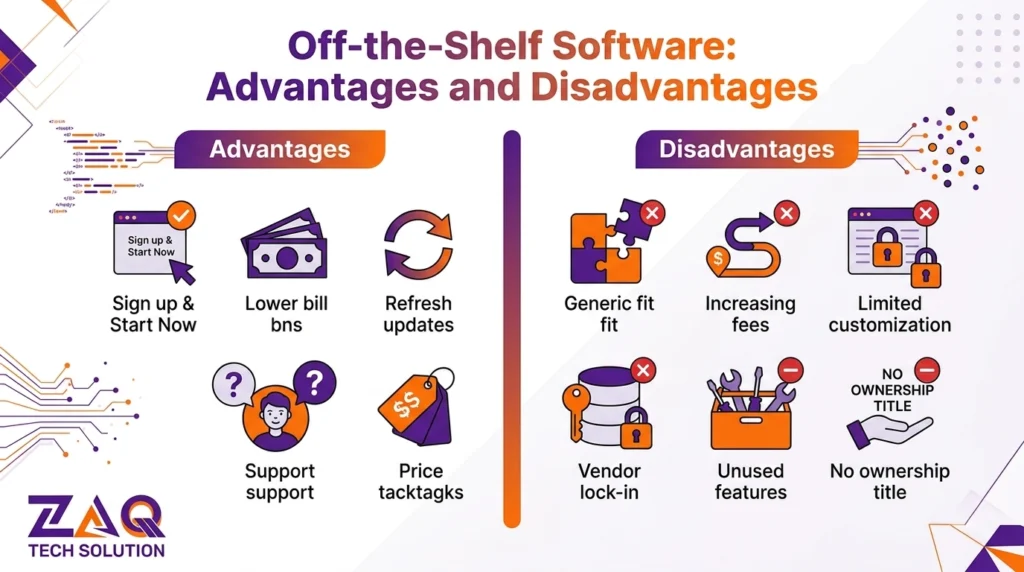
Advantages of Off-the-Shelf Software
- Immediate availability — sign up and start using it today
- Lower upfront cost, especially for small teams
- Regular vendor updates and new features included
- Established support communities, documentation, and tutorials
- Predictable pricing through subscription tiers.
Disadvantages of Off-the-Shelf Software
- Generic functionality that rarely fits 100% of your process
- Recurring costs that compound — monthly fees add up fast over 3-5 years
- Limited customization, often locked behind expensive “enterprise” tiers
- Vendor lock-in — switching later can mean losing historical data
- Paying for unused features bundled into pricing packages
- No ownership — the vendor can change pricing, features, or shut down entirely.
Comparison Table: Off-the-Shelf Software Advantages and Disadvantages
| Factor | Advantage | Disadvantage |
| Deployment speed | Ready to use immediately | — |
| Initial cost | Low upfront cost | Recurring fees add up over time |
| Customization | Some configuration options | Core logic can’t be changed |
| Support | Vendor-provided documentation | Generic, not business-specific |
| Ownership | — | You never own the software |
| Scalability | Works for standard use cases | Struggles with unique growth needs |
Bespoke Software vs Ready-Made Software: Key Differences
People often search “bespoke software vs ready-made software” expecting a different answer than “custom vs off-the-shelf” — but they’re the same comparison, just different terminology (bespoke = custom, ready-made = off-the-shelf).
| Aspect | Bespoke (Custom) Software | Ready-Made (Off-the-Shelf) Software |
| Design | Built for one specific business | Built for a general market |
| Ownership | Full source code ownership | License-based usage only |
| Flexibility | Fully adaptable | Limited to vendor’s design |
| Upfront cost | Higher | Lower |
| Long-term cost | Often lower over 3+ years | Recurring, compounding cost |
| Time to launch | Weeks to months | Immediate |
| Integration | Custom-built connections | Depends on available APIs |
| Data ownership | Full control | Shared with or controlled by vendor |
Cost Comparison: Custom vs Off-the-Shelf Software
This is usually the deciding factor, so let’s be direct about it.
Off-the-shelf software costs less upfront (often $20–$300 per user/month) but the cost never stops — you pay for as long as you use it, and prices typically increase over time as vendors raise subscription tiers.
Custom software requires a larger initial investment (project-based pricing depending on complexity) but has no recurring license fee — you own it outright once it’s built.
Simple Cost Breakdown (3-Year Outlook)
| Cost Factor | Off-the-Shelf | Custom Software |
| Setup cost | Low | Medium to high |
| Monthly/annual fees | Yes, ongoing | None (maintenance only) |
| Customization cost | Extra, often locked | Included in build |
| Scaling cost | New license tiers | Incremental development |
| 3-year total (mid-size team) | Often higher due to compounding fees | Often lower after year 2–3 |
| Exit cost | Data migration risk | You retain full ownership |
Rule of thumb: if your team is under 10 people with simple, standard needs, off-the-shelf usually wins on cost. If you’re scaling past 20+ users with unique workflows, custom software typically becomes cheaper within 2-3 years.
Expert tip: Before comparing sticker prices, calculate your 3-year total cost of ownership (TCO) for both options. Most businesses are shocked to see how much recurring SaaS fees add up compared to a one-time custom build.
Which Is Better — Custom or Off-the-Shelf Software?
Neither is universally better — the right choice depends on your business’s uniqueness, budget, and growth stage. Off-the-shelf software wins for standard, common processes (accounting, basic CRM, email). Custom software wins when your workflows are unique, your business is scaling fast, or off-the-shelf tools force you to compromise on how you operate.
Choose Off-the-Shelf Software If:
- Your processes are standard and industry-common
- You need something running within days, not weeks
- Your budget is limited and short-term
- You’re a very early-stage startup still validating your model.
Choose Custom Software If:
- Your workflows are genuinely unique to your business
- You’re scaling and existing tools are becoming a bottleneck
- Data security and full ownership matter to your industry
- You want a long-term system without recurring license dependency
- You need deep integration across multiple existing systems.
Benefits of Custom Software for Business Growth
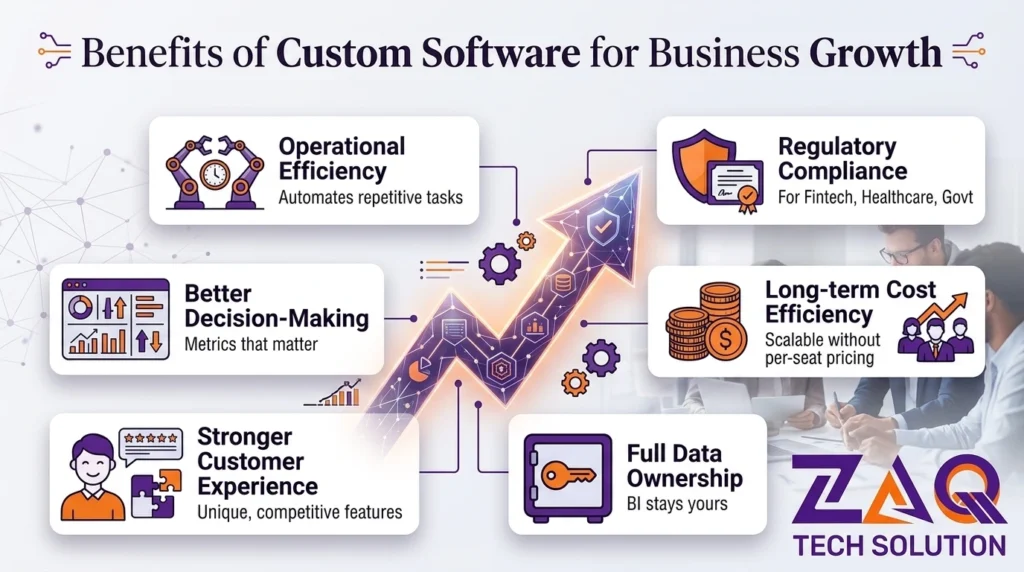
Beyond the pros/cons list, here’s what custom software actually does for a growing business:
- Operational efficiency — automates the exact repetitive tasks slowing your team down
- Better decision-making — custom dashboards surface the metrics that matter to your business
- Stronger customer experience — build features your competitors literally cannot replicate overnight
- Regulatory compliance — critical for healthcare, fintech, and government-adjacent industries
- Long-term cost efficiency — no per-seat pricing punishing you for growing your team
- Full data ownership — your business intelligence stays yours, not a vendor’s database
Industry research consistently shows that businesses using tailored digital systems report higher process efficiency than those relying entirely on generic tools, largely because custom systems remove the manual workarounds teams build to compensate for software limitations.
How to Choose the Right Option for Your Business
Ask yourself these four questions before deciding:
- Is my workflow standard or unique? Standard → off-the-shelf. Unique → custom.
- What’s my 3-year budget outlook, not just this month’s budget?
- How fast am I scaling? Rapid growth exposes off-the-shelf limitations quickly.
- How sensitive is my data? Regulated industries often need custom-built security controls.
A hybrid approach also works well for many businesses: start with off-the-shelf tools to validate your model, then move to custom software once your processes stabilize and scale.
Why Work With a Custom Software Development Company in Pakistan
Pakistan has become a strong hub for cost-effective, high-quality custom software development, offering businesses access to experienced development teams at a fraction of Western agency rates — without compromising on code quality or communication.
At ZAQ Tech, we work as a full custom software development company in Pakistan, building everything from ERP systems and business intelligence dashboards to custom customer portals and admin panels. Our approach starts with understanding your actual workflow — not pushing a template — because we believe software should adapt to your business, not the other way around.
Whether you’re automating internal operations, replacing a limiting off-the-shelf tool, or building a completely new system from scratch, our team handles the full lifecycle: discovery, design, development, testing, and long-term support.
Expert Tips Before You Decide
- Don’t decide on price alone. Compare 3-year total cost of ownership, not just the first invoice.
- List your “must-have” vs “nice-to-have” features. If 80% of your needs are standard, off-the-shelf may suffice.
- Ask about data portability before signing any off-the-shelf contract — know how hard it is to leave later.
- Start with a discovery call, not a full build, when evaluating a custom software partner.
- Check post-launch support terms. Custom software needs a maintenance plan; make sure it’s included.
- Pilot before you commit. Whether custom or off-the-shelf, test with a small team first.
FAQs
Q1: What is the main difference between custom software and off-the-shelf software?
A: Custom software is built specifically for one business’s needs, while off-the-shelf software is a pre-built product sold to many businesses with limited customization options.
Q2: Is custom software more expensive than off-the-shelf software?
A: Custom software has a higher upfront cost, but off-the-shelf software often costs more over 3+ years due to recurring subscription fees and add-on charges.
Q3: Which is better for small businesses — custom or off-the-shelf software?
A: Most small businesses with standard needs benefit from off-the-shelf software initially, then transition to custom software as their workflows become more complex and scaling demands increase.
Q4: How long does custom software development take?
A: Depending on complexity, custom software typically takes anywhere from 6 weeks for a simple tool to 6+ months for a full enterprise system.
Q5: Can off-the-shelf software be customized?
A: Some off-the-shelf platforms allow configuration and add-ons, but core functionality and underlying architecture usually can’t be changed, unlike fully custom-built systems.
Q6: Does custom software require ongoing maintenance?
A: Yes. Custom software needs periodic updates, security patches, and support — typically handled through a maintenance agreement with your development partner.
Q7: Is off-the-shelf software less secure than custom software?
A: Not inherently, but custom software allows you to build security controls specific to your data and compliance requirements, which matters most in regulated industries like healthcare and finance.
Conclusion
There’s no universal winner between custom and off-the-shelf software — only the right fit for where your business is today, and where it’s headed next. Standard needs and tight timelines favor ready-made tools. Unique workflows, scaling teams, and long-term ownership favor custom-built systems.
If you’re still weighing your options, it’s worth getting an outside opinion from a team that builds both — and has no incentive to push you toward the more expensive choice just because it pays better.
Need help deciding? Talk to ZAQ Tech, a trusted custom software development company in Pakistan, for a free discovery consultation on whether custom or off-the-shelf software fits your business best.
Building the right software is only half the equation — getting found online is the other half. If you’re comparing technology investments, it’s also worth understanding how on-page SEO, technical SEO, and off-page SEO work together, reviewing your Google Business Profile optimization for local visibility, and choosing the best SEO company in Pakistan to make sure your new software actually gets discovered by customers.
Pingback: 7 Signs You Need Custom Software Development
Pingback: Flutter vs React Native for Mobile App Development in 2026