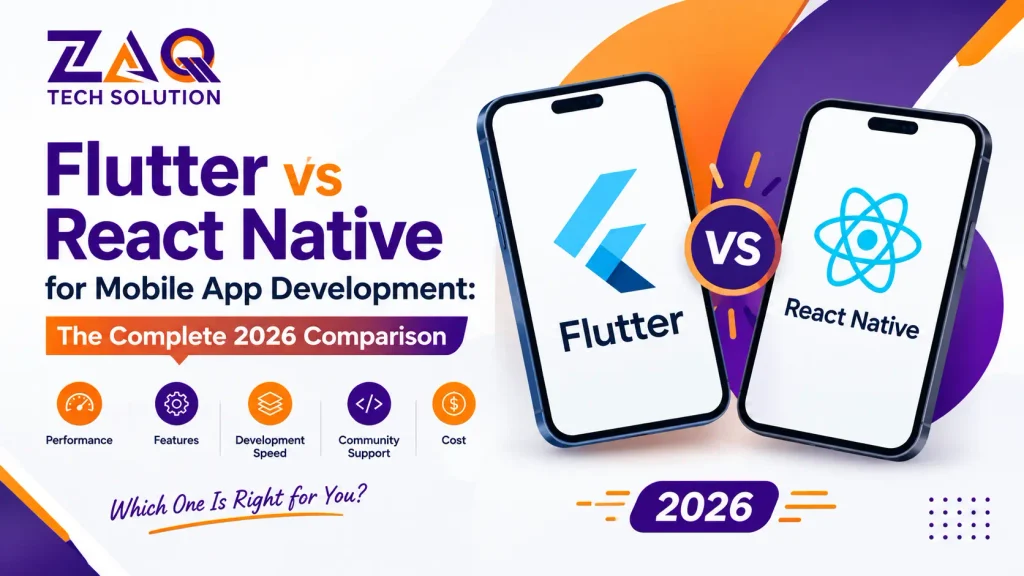
If you’re building a mobile app right now, you’ve almost certainly hit the same wall every founder and product manager hits: should you go with Flutter or React Native?
You’re not alone in asking. It’s one of the most searched questions in mobile development, and honestly, there’s no single “always correct” answer — it depends on your team, your budget, and what you’re building.
Here’s our promise: by the end of this guide, you’ll know exactly which framework fits your project, backed by real performance data, cost breakdowns, and hiring realities — not just theory.
We’ll walk through everything: what each framework actually is, how they perform head-to-head, what they cost to build and maintain, and which one makes more sense for startups versus enterprises heading into 2026.
Which Is Better, Flutter or React Native?
Flutter is generally better for apps that need pixel-perfect custom UI, high performance, and long-term consistency across platforms, because it compiles to native ARM code and doesn’t rely on a JavaScript bridge. React Native is often better when your team already knows JavaScript/React, you need faster access to native modules, or you’re building an MVP with a lean web-dev team. Neither is “wrong” — the right choice depends on your app’s complexity, your budget, and your developers’ existing skill set.
What Is Flutter?
Flutter is an open-source UI toolkit built by Google that lets developers build natively compiled apps for mobile, web, and desktop from a single Dart codebase.
Flutter doesn’t use native UI components. Instead, it draws every pixel on the screen itself using its own rendering engine (Skia, transitioning to Impeller on newer versions).
That’s why Flutter apps look and behave identically on both iOS and Android — nothing gets lost in translation.
Key facts about Flutter:
- Released by Google in 2017
- Written in Dart, a language optimized for UI building
- Compiles to native ARM/x86 machine code — no JavaScript bridge
- Powers apps like Google Pay, BMW, Alibaba’s Xianyu, and Toyota’s in-vehicle infotainment
- Ships with a huge library of customizable, pre-built widgets.
What Is React Native?
React Native is an open-source framework created by Meta (Facebook) that allows developers to build mobile apps using JavaScript and React, rendering to actual native UI components on iOS and Android.
Unlike Flutter, React Native talks to native components through a communication layer (historically a “bridge,” now increasingly the newer JSI/Fabric architecture).
This means your buttons, text fields, and navigation bars are the real native elements the platform provides — not a custom-drawn imitation.
Key facts about React Native:
- Released by Meta in 2015
- Built on JavaScript and React, one of the world’s most widely used web frameworks
- Uses native UI components under the hood
- Powers apps like Instagram, Discord, Shopify, and Walmart
- Backed by an enormous existing pool of JavaScript developers.
Flutter vs React Native: Performance Comparison
In most benchmark tests, Flutter edges out React Native on raw performance because it compiles directly to native machine code and avoids the JavaScript bridge, resulting in smoother animations and faster startup times — though React Native’s newer Fabric/JSI architecture has significantly closed the gap.
Why Flutter Tends to Perform Better
- No bridge overhead — Flutter code compiles ahead-of-time (AOT) into native ARM code, so there’s no runtime translation layer slowing things down.
- Consistent 60–120fps rendering — because Flutter owns the entire rendering pipeline, animations stay smooth even on complex screens.
- Predictable performance across devices — the same rendering engine runs everywhere, so you don’t get platform-specific rendering quirks.
Where React Native Holds Its Own
- Fabric renderer + JSI — Meta’s newer architecture removes much of the old async bridge bottleneck, bringing React Native much closer to native-level responsiveness.
- Native modules — for camera-heavy, AR, or hardware-intensive features, React Native can drop into fully native Swift/Kotlin code when needed.
- Startup time — for lighter apps, React Native’s cold-start times are competitive with Flutter’s.
for graphics-heavy apps, custom animations, or apps that must look identical on every device, Flutter usually wins. For apps leaning heavily on native device APIs or existing native modules, React Native can perform just as well.
Flutter vs React Native: Full Comparison Table
| Factor | Flutter | React Native |
| Language | Dart | JavaScript / TypeScript |
| Performance | Near-native, compiles to machine code | Very good, improving with Fabric/JSI |
| UI Consistency | Identical on iOS & Android (self-drawn widgets) | Uses native components (may vary slightly by platform) |
| Learning Curve | Moderate — Dart is new to most devs | Easier — familiar to any React/JS developer |
| Hiring Pool | Smaller, growing fast | Very large (JS is one of the most common skills) |
| Development Cost | Slightly lower long-term (single codebase, fewer bugs) | Competitive, but may need more native module work |
| Best Use Case | Custom UI, branding-heavy apps, MVPs to enterprise apps | Apps needing fast web-team reuse, social/media apps |
| Backed By | Meta | |
| Hot Reload | Yes | Yes |
| Package Ecosystem | Growing (pub.dev) | Massive (npm) |
Cost of Flutter vs React Native App Development
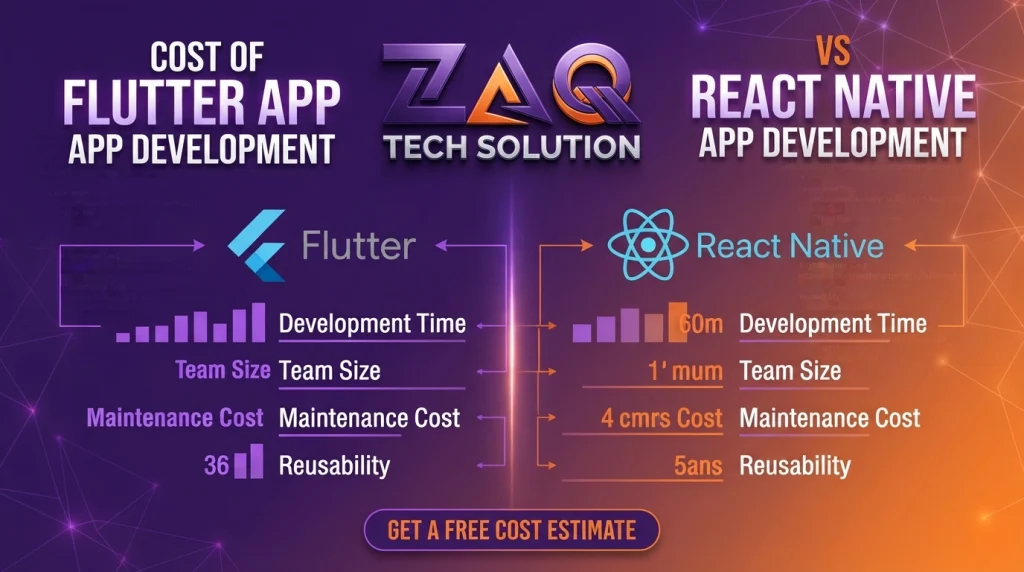
On average, cross-platform apps built with either Flutter or React Native cost 30–40% less than building separate native iOS and Android apps, since a single codebase serves both platforms.
Here’s a general cost breakdown for the Pakistani and international market:
| App Complexity | Estimated Cost Range (USD) | Typical Timeline |
| Simple MVP app | $5,000 – $15,000 | 4–8 weeks |
| Mid-complexity app (custom UI, APIs, payments) | $15,000 – $40,000 | 2–4 months |
| Complex, enterprise-grade app | $40,000 – $100,000+ | 4–8+ months |
What Actually Drives the Cost
- Number of screens and custom UI complexity
- Third-party integrations (payment gateways, maps, chat, push notifications)
- Backend and API development
- Design and UX work
- Post-launch maintenance and updates.
Flutter can shave down long-term maintenance costs because your UI code is more predictable and consistent — fewer “it looks fine on iOS but broken on Android” bugs to chase down. React Native can be cheaper upfront if your team already has strong JavaScript talent in-house, since onboarding is faster.
If you’re weighing custom development against buying an off-the-shelf solution, it’s worth understanding the trade-offs first — our breakdown of custom software vs off-the-shelf software covers exactly that decision.
React Native vs Flutter for Startups
Startups have different priorities than enterprises: speed to market, lean budgets, and the ability to pivot fast.
For startups, React Native is often the faster route to an MVP if the founding team already has web/JavaScript developers, while Flutter is the better long-term bet if pixel-perfect branding and scaling to multiple platforms (web, desktop) matter from day one.
Choose React Native If You’re a Startup That:
- Already has JavaScript/React developers on the team
- Needs to launch an MVP in weeks, not months
- Plans to reuse code or logic between a web app and mobile app
- Relies heavily on existing native modules and third-party SDKs.
Choose Flutter If You’re a Startup That:
- Wants a highly branded, custom UI that stands out from typical app templates
- Plans to expand to web and desktop from the same codebase later
- Wants fewer platform-specific bugs during rapid iteration
- Is optimizing for long-term maintenance simplicity over short-term familiarity.
If your product idea is still evolving and you’re not sure whether you actually need a fully custom-built app yet, it helps to first check the signs you need custom software development before committing budget to either framework.
Best Framework for Cross-Platform App Development in 2026
Heading into 2026, Flutter continues to gain ground as the preferred framework for new cross-platform projects, driven by Google’s continued investment, its expanding support for web and desktop, and its increasingly mature ecosystem — while React Native remains the stronger choice for teams already embedded in the JavaScript/React ecosystem.
Industry Trends Worth Knowing
- Flutter’s adoption has grown steadily among agencies and enterprises building multi-platform products (mobile + web + desktop) from one codebase.
- React Native’s Fabric architecture rollout has made it a much stronger competitor on performance than it was a few years ago.
- Both frameworks now have mature CI/CD tooling, making automated testing and deployment far less painful than in earlier years.
- AI-assisted development tools are increasingly optimized for both Dart and JavaScript, narrowing the productivity gap between the two ecosystems.
Our take: there is no universal “best” framework in 2026 — the right pick depends on your team’s existing skills, your UI ambitions, and your platform roadmap. What matters more than the framework itself is choosing a development partner who can execute it well.

Flutter App Development Company in Pakistan
Pakistan’s mobile app development market has grown quickly, with agencies across Rawalpindi, Islamabad, Lahore, and Karachi now delivering Flutter and React Native apps for local and international clients.
ZAQ Tech is a mobile app development company based in Rawalpindi, Pakistan, building cross-platform apps with Flutter, React Native, Kotlin, and Swift for startups and established businesses across healthcare, fintech, logistics, education, and e-commerce.
Why Businesses in Pakistan Choose a Local Flutter Development Partner
- Cost efficiency — Pakistani development rates are significantly lower than US/UK/EU agencies, without sacrificing quality.
- Time zone alignment — easier real-time collaboration for regional clients across the Middle East and South Asia.
- Full-cycle expertise — from UI/UX design to development, testing, deployment, and post-launch support.
- Growing technical talent pool — a rising number of skilled Dart and JavaScript developers in Rawalpindi and Islamabad.
At ZAQ Tech, every mobile app project — whether Flutter or React Native — goes through ideation, UI/UX design, development, QA testing, and app store deployment on both Android and iOS, with ongoing support after launch.
Expert Tips: How to Choose the Right Framework
- Audit your team’s existing skills first. If you already have strong JavaScript developers, React Native reduces onboarding friction significantly.
- Prototype your most complex UI screen early. If it needs highly custom animations or branding, lean toward Flutter.
- Don’t choose based on hype alone. Both frameworks are production-proven at massive scale — Google Pay (Flutter) and Instagram (React Native) are proof of that.
- Plan for multi-platform expansion upfront. If web or desktop is on your 12–24 month roadmap, Flutter’s single-codebase approach saves real money later.
- Budget for maintenance, not just launch. Cheaper upfront development can mean costlier long-term maintenance if the wrong framework is matched to your app’s complexity.
- Work with a partner who’s shipped both. A development team experienced in both frameworks can recommend based on your actual app, not a one-size-fits-all bias.
FAQs
Q1: Is Flutter better than React Native in 2026?
A: Flutter generally offers better raw performance and UI consistency, while React Native offers a larger hiring pool and faster onboarding for JavaScript teams. The “better” choice depends on your specific app and team.
Q2: Which is easier to learn, Flutter or React Native?
A: React Native is typically easier to pick up if you already know JavaScript and React. Flutter requires learning Dart, which has a moderate learning curve but is considered beginner-friendly.
Q3: Is Flutter faster than React Native?
A: In most benchmarks, yes — Flutter compiles to native machine code and avoids a JavaScript bridge, giving it an edge in animation smoothness and rendering speed, especially in graphics-heavy apps.
Q4: How much does it cost to build an app in Flutter vs React Native?
A: Cost differences between the two frameworks are usually minor; total cost depends more on app complexity, integrations, and design work than the framework choice itself. Expect $5,000–$100,000+ depending on scope.
Q5: Which is better for a startup: Flutter or React Native?
A: React Native suits startups with existing JavaScript talent needing a fast MVP. Flutter suits startups prioritizing custom branding, UI consistency, and future expansion to web or desktop.
Q6: Can I switch from React Native to Flutter later?
A: Technically yes, but it typically means rebuilding the UI layer from scratch since the two frameworks aren’t code-compatible. It’s better to choose carefully upfront based on your app’s roadmap.
Q7: Do big companies use Flutter or React Native?
Both. Flutter powers apps like Google Pay, BMW, and Alibaba’s Xianyu. React Native powers apps like Instagram, Discord, Shopify, and Walmart.
Q8: Is React Native dying in 2026?
A: No. React Native remains widely used and actively maintained by Meta, with continued investment in its new Fabric and JSI architecture to close the performance gap with native and Flutter apps.
Conclusion
There’s no universal winner in the Flutter vs React Native debate — only the right fit for your specific app, team, and timeline.
If you want native-level performance and pixel-perfect branding across platforms, Flutter is likely your answer. If your team already lives in JavaScript and you need to move fast, React Native gets you there efficiently.
What matters most is working with a development partner who’s actually shipped production apps in both — not just one.
Need a Flutter or React Native app built? Our Mobile App Development team at ZAQ Tech can help you scope, design, and build your app the right way — from the first wireframe to app store launch. And if visibility after launch is part of your plan, our guide on Google Business Profile optimization in Pakistan is a good next read for getting found locally.