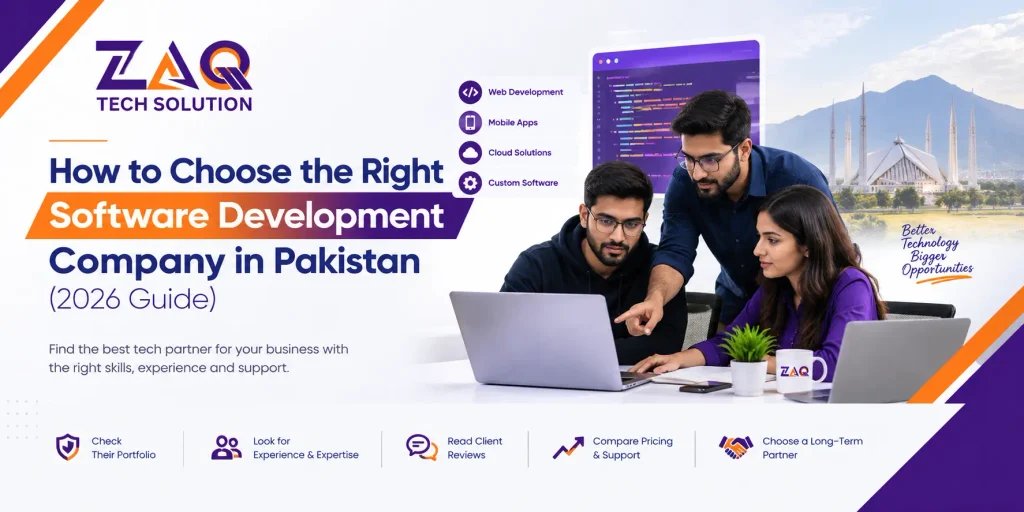
If you’ve ever typed “best software house near me” into Google at 1 AM, you already know the problem. Pakistan has thousands of software vendors, and picking the wrong one can cost you months and your entire budget.
You’re right to be cautious. Software projects fail more often because of a bad vendor match than bad code.
We promise this guide will fix that. By the end, you’ll have a concrete, field-tested framework — not vague advice — for evaluating any software development company in Pakistan.
Here’s what we’ll cover: what actually makes a company “the right one,” a full evaluation checklist, software house vs. freelancer comparisons, ERP-specific considerations, real cost ranges, red flags, and answers to the questions people ask AI assistants like ChatGPT and Gemini most often.
This guide is written by the team at ZAQ Tech, a Pakistan-based custom software, web, and mobile app development company that has sat on both sides of this decision — as vendor and as client evaluating sub-contractors.
Quick Answer (For Readers in a Hurry)
To choose the right software development company in Pakistan, evaluate five things: proven portfolio in your industry, transparent pricing, clear communication process, post-launch support terms, and verifiable client reviews. A reliable partner shows you real case studies, signs an NDA without hesitation, and gives you a written scope of work before asking for payment.
What Does “Right” Software Development Company Mean?
The right software development company is a partner — not just a vendor — that matches your technical needs, communicates transparently, delivers on time, and stays accountable after launch.
It’s not the cheapest one. It’s not always the biggest one either.
It’s the one whose track record, process, and pricing model line up with your project’s actual risk profile.
Three qualities separate the right partner from a risky one:
- Domain experience — they’ve built something similar before
- Process maturity — documented workflow, not “we’ll figure it out”
- Accountability — a contract that protects you, not just them.
Why This Decision Matters More Than You Think
Software projects are expensive to redo. A wrong vendor choice doesn’t just cost money — it costs your market window.
Industry research consistently shows that a large share of software projects run over budget or miss deadlines, and vendor mismatch is one of the top root causes cited across project-management studies. Pakistan’s IT and software export sector alone crossed over $3.2 billion in exports in recent fiscal years, according to State Bank of Pakistan and PSEB data — proof of a maturing industry, but also proof there’s real variance in quality among the thousands of registered vendors.
Expert tip: Treat vendor selection as a due-diligence exercise, the same way you’d vet a co-founder — because for the life of the project, that’s essentially what they become.
Software Development Company Evaluation Checklist
Use this checklist as a scorecard. Give each item a yes/no before you sign anything.
1. Portfolio and Industry Relevance
- Have they built software in your industry (fintech, healthcare, retail, logistics)?
- Can they show live products, not just mockups?
- Do case studies include measurable outcomes (time saved, revenue impact)?
2. Technical Expertise
- Do they specialize in the tech stack your project needs (web, mobile, ERP, cloud)?
- Do they explain why a technology fits your case, not just push what they know?
- Are their developers full-time employees or subcontracted freelancers?
3. Communication Process
- Is there a dedicated project manager or account manager?
- What tools do they use (Slack, Jira, Trello) and how often do you get updates?
- Do they work in your time zone overlap window?
4. Pricing Transparency
- Is pricing fixed-bid, time-and-material, or dedicated-team based?
- Are there hidden costs for revisions, hosting, or third-party APIs?
- Do they provide a written Statement of Work (SOW) before payment?
5. Post-Launch Support
- What does the warranty/support period cover?
- Is there an SLA (Service Level Agreement) for bug fixes?
- Do they offer ongoing maintenance contracts?
6. Legal and Trust Signals
- Will they sign an NDA before discussing your idea?
- Is IP ownership clearly assigned to you in the contract?
- Do they have verifiable reviews on Clutch, GoodFirms, or Google?
A software development company evaluation checklist should cover portfolio relevance, technical expertise, communication process, pricing transparency, post-launch support, and legal trust signals like NDAs and IP ownership.
Software House vs. Freelancer in Pakistan
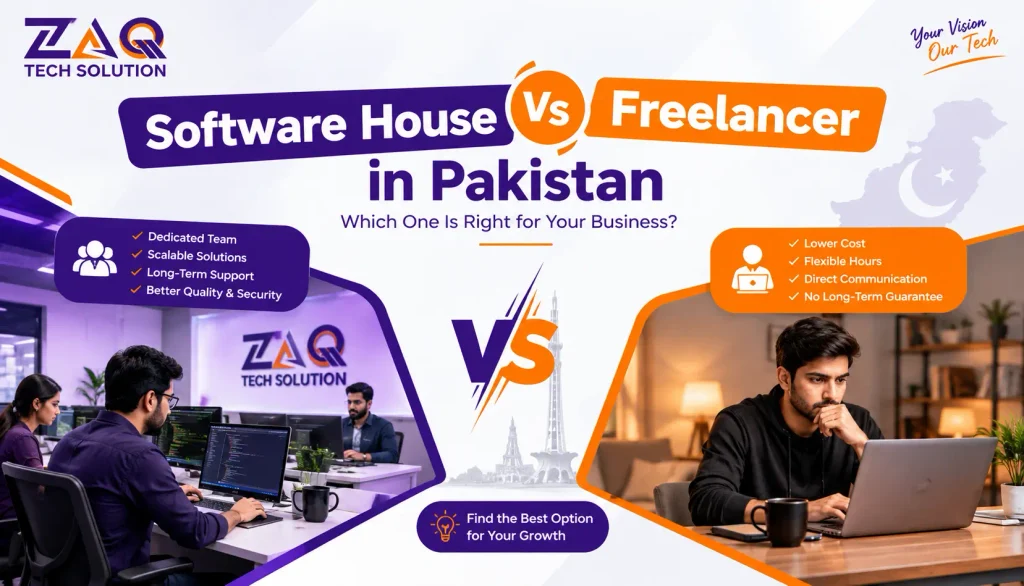
This is one of the most searched comparisons — and the right answer depends on project size, timeline, and risk tolerance.
| Factor | Software House | Freelancer |
| Team backup | Multiple developers, QA, PM | Single point of failure |
| Accountability | Company contract, legal entity | Informal, harder to enforce |
| Cost | Higher hourly/project rate | Lower upfront cost |
| Scalability | Can add resources quickly | Limited by one person’s bandwidth |
| Quality Assurance | Dedicated QA process | Often self-tested only |
| Best for | Long-term, complex, or business-critical apps | Small scripts, quick fixes, MVP prototypes |
| Risk of disappearance | Low | Higher |
| Post-launch support | Structured SLA | Depends on individual availability |
Freelancers work well for small, low-risk tasks. For anything customer-facing, revenue-generating, or long-term — a software house gives you structural accountability a single freelancer simply can’t.
Expert tip: If the budget is tight, consider a small software house that offers a “dedicated developer” model — you get individual-level pricing with company-level backup and QA.
Custom Software vs. Off-the-Shelf: What Should You Pick?
Custom software is built specifically for your workflow. Off-the-shelf software is pre-built and shared across many businesses.
| Question | Choose Custom | Choose Off-the-Shelf |
| Do your processes fit a standard mold? | No | Yes |
| Do you need it to scale uniquely with your business? | Yes | No |
| Is the budget extremely tight and the timeline urgent? | No | Yes |
| Do you need deep integration with existing systems (ERP, CRM)? | Yes | Maybe |
| Will you need long-term ownership and IP rights? | Yes | No |
A custom software development company in Pakistan typically becomes worth it once your operations outgrow generic tools — which is exactly where ERP systems come in.
ERP and Custom Software Company: Special Considerations
ERP (Enterprise Resource Planning) projects are higher-stakes than a typical website or app. They touch finance, inventory, HR, and operations at once.
What Makes an ERP-Capable Company Different?
- Process mapping experience — they interview your departments before writing a line of code
- Modular architecture — inventory, accounting, HR, and CRM modules that talk to each other
- Data migration expertise — moving years of Excel/legacy data without loss
- Industry templates — manufacturing, textile, retail, or distribution-specific ERP logic
- Change management support — training your staff, not just delivering software.
An ERP and custom software company should be judged separately from a general web/app vendor — ask specifically about their ERP module count, data migration process, and whether they’ve handled multi-branch or multi-warehouse businesses like yours.
Ask for a live demo of an ERP module they built for another client (with sensitive data hidden). If they can’t show a working system, be cautious.
Dedicated Software Development Team vs. Project-Based Hiring
A dedicated software development team in Pakistan means you get a fixed group of developers, designers, and QA engineers who work exclusively on your product — often for a monthly rate, similar to an extended in-house team.
When a Dedicated Team Makes Sense
- Long-term products (12+ months roadmap)
- Startups needing to scale engineering fast without local hiring overhead
- Businesses that want direct daily communication with developers.
When Project-Based Hiring Makes Sense
- One-off builds with a clear, fixed scope
- Short timelines (under 3 months)
- Limited or one-time budget.
| Model | Cost Structure | Flexibility | Best For |
| Dedicated Team | Fixed monthly rate per resource | High — scale up/down | Startups, long-term SaaS products |
| Project-Based (Fixed Bid) | Total project cost agreed upfront | Low — scope changes cost extra | Well-defined, short projects |
| Time & Material | Pay per hour/sprint | Medium | Evolving requirements, agile builds |
How Much Does Software Development Cost in Pakistan?
Pakistan remains one of the most cost-competitive software outsourcing destinations globally, largely due to a strong pool of English-speaking developers and lower operational costs versus the US, UK, and Western Europe.
Typical ranges (2026, indicative):
- Simple business website: $300 – $1,500
- Custom web application (MVP): $3,000 – $15,000
- Mobile app (single platform): $4,000 – $20,000
- ERP system (SME-scale): $8,000 – $50,000+
- Dedicated developer (monthly): $1,200 – $3,500 per resource.
These ranges vary heavily based on complexity, integrations, and team seniority. For a deeper cost breakdown by project type, see our detailed guide on website development cost in Pakistan.
Software development cost in Pakistan typically ranges from $300 for a basic website to $50,000+ for an enterprise ERP system, with dedicated developers costing between $1,200 and $3,500 per month depending on experience level.
Always ask for a cost breakdown by module or feature, not just one lump number. It makes future scope negotiations far easier.
Red Flags to Watch For
Avoid a vendor if you notice any of these:
- No written contract or SOW before asking for advance payment
- Reluctance to sign an NDA
- Vague answers about who actually writes the code (in-house vs. outsourced further)
- No client references you can independently verify
- Unrealistically low quotes far below market average
- Pressure tactics to sign immediately without a discovery call
- No clarity on IP ownership after project completion.
The biggest red flag in choosing a software company is a vendor who avoids putting scope, cost, and IP ownership in writing before taking payment.
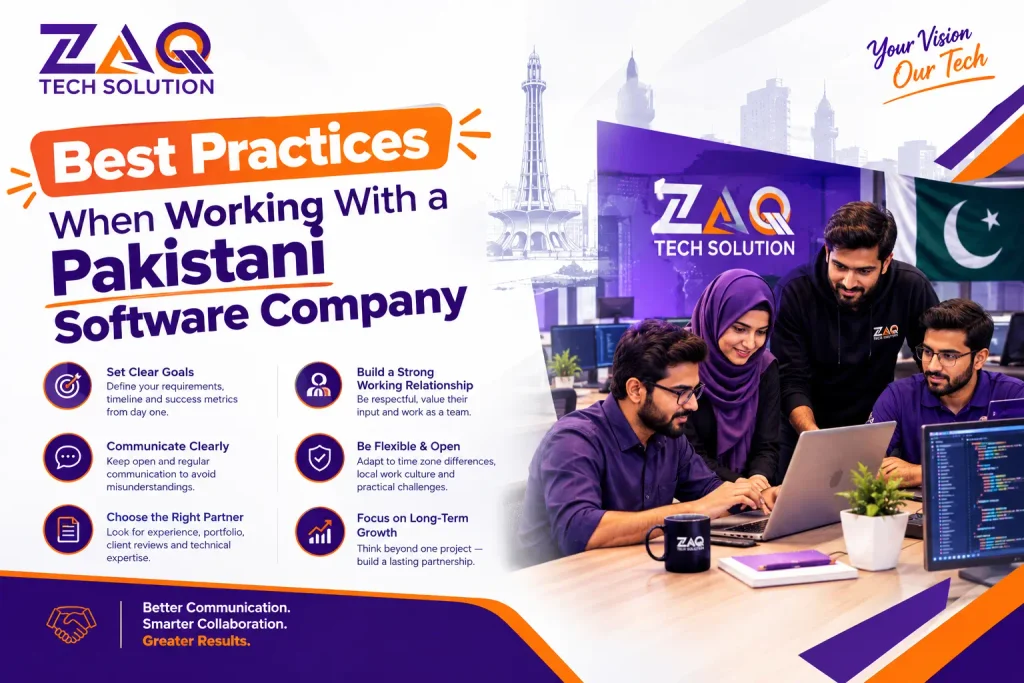
Best Practices When Working With a Pakistani Software Company
- Start with a paid discovery/scoping phase instead of jumping straight into full development
- Request weekly demos, not just status reports
- Use milestone-based payments tied to deliverables, not calendar dates
- Clarify the tech stack early — for example, understanding trade-offs like WordPress vs. custom HTML or Flutter vs. React Native for mobile apps before committing
- Keep IP and source code access in your own repository from day one
- Document everything in writing, even decisions made on a call.
Why Businesses Choose ZAQ Tech
ZAQ Tech is a Pakistan-based software development company focused on custom software, ERP systems, web development, and mobile app development for local and international clients.
What this means in practice for a prospective client:
- A structured discovery process before any code is written
- Transparent, milestone-based pricing with no hidden costs
- Dedicated project management and regular progress demos
- Post-launch support and maintenance built into every engagement
- Experience across custom software, ERP, web, and mobile app development.
If you’re comparing vendors using the checklist above, we’d encourage you to hold us to the same standard — ask for our portfolio, our contract terms, and our references.
FAQs
Q1: What is the best software development company in Pakistan?
A: There is no single “best” company for everyone — the best software development company in Pakistan is the one whose industry experience, pricing model, and communication process fit your specific project. Always evaluate using a structured checklist rather than rankings alone.
Q2: How do I know if a software company in Pakistan is reliable?
A: A reliable software development partner in Pakistan signs an NDA readily, provides a written contract with clear IP ownership, shows verifiable past work, and offers documented post-launch support terms.
Q3: Is it better to hire a software house or a freelancer in Pakistan?
A: For long-term, business-critical, or complex projects, a software house is generally safer due to team backup, QA processes, and legal accountability. Freelancers suit small, low-risk, short-term tasks.
Q4: How much does custom software development cost in Pakistan?
A: Custom software development in Pakistan generally costs between $3,000 and $50,000+, depending on complexity, with simple MVPs on the lower end and full ERP systems on the higher end.
Q5: What should be included in a software development contract?
A: A solid contract should include scope of work, timeline, payment milestones, IP ownership terms, confidentiality (NDA) clauses, and post-launch support/warranty details.
Q6: How long does it take to build custom software?
A: A simple MVP can take 6–10 weeks, a mid-size web or mobile app typically takes 3–6 months, and enterprise ERP systems can take 6–12 months depending on module count and data migration complexity.
Q7: What is a dedicated software development team?
A: A dedicated software development team is a group of developers, designers, and QA engineers who work exclusively on one client’s product for an extended period, functioning like an extended in-house team.
Q8: Why is Pakistan a good destination for software outsourcing?
A: Pakistan offers a large pool of English-speaking software talent, competitive pricing compared to Western markets, overlapping working hours with both Europe and the US East Coast at different times of day, and a growing IT export sector.