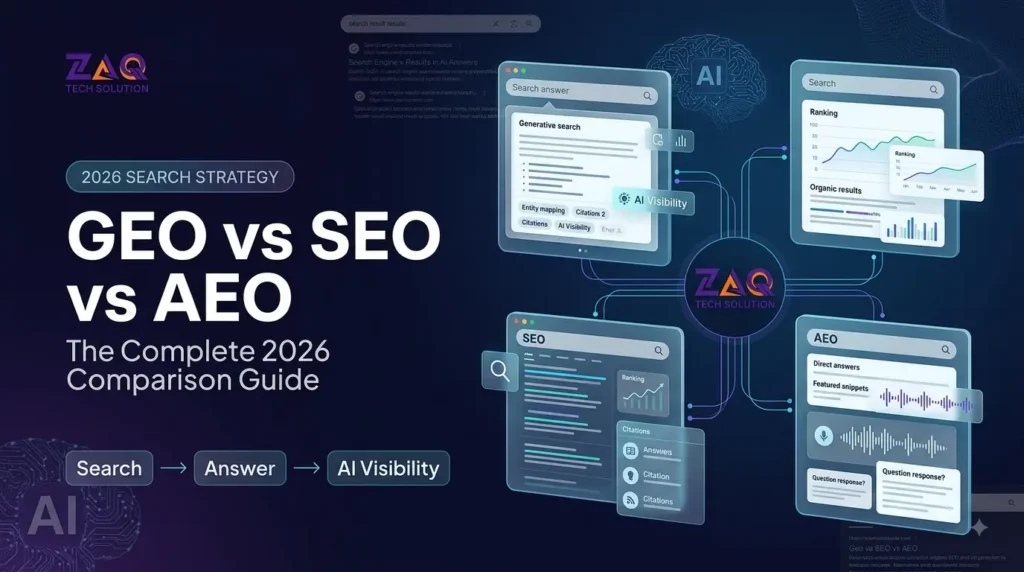
GEO vs SEO vs AEO: The Complete 2026 Comparison Guide
If you’ve been reading about search strategy lately, you’ve probably run into three confusing acronyms in the same paragraph — SEO, AEO, and now GEO. We agree, it’s a lot to untangle, especially when each one sounds like it’s trying to replace the other.
Here’s our promise: this guide will give you clear, no-fluff definitions of all three, a direct side-by-side comparison, and a practical roadmap for using them together — whether you run a local business in Islamabad or manage a national brand.
We’ll walk through what each term actually means, how they overlap, where they differ, how to rank in Google AI Overviews and ChatGPT specifically, and how much this kind of strategy typically costs in Pakistan.
SEO optimizes for search engine rankings, AEO optimizes for being extracted as a direct answer, and GEO optimizes for being cited within AI-generated responses on platforms like ChatGPT, Gemini, and Perplexity. All three work toward the same goal — visibility — but target different parts of the search journey.
What Is SEO, AEO, and GEO?
Let’s start with clean, citation-ready definitions — the kind AI engines tend to lift directly.
What Is SEO?
Search Engine Optimization (SEO) is the practice of improving a website’s structure, content, and authority so it ranks higher in traditional search engine results pages, driving organic click-through traffic.
What Is AEO?
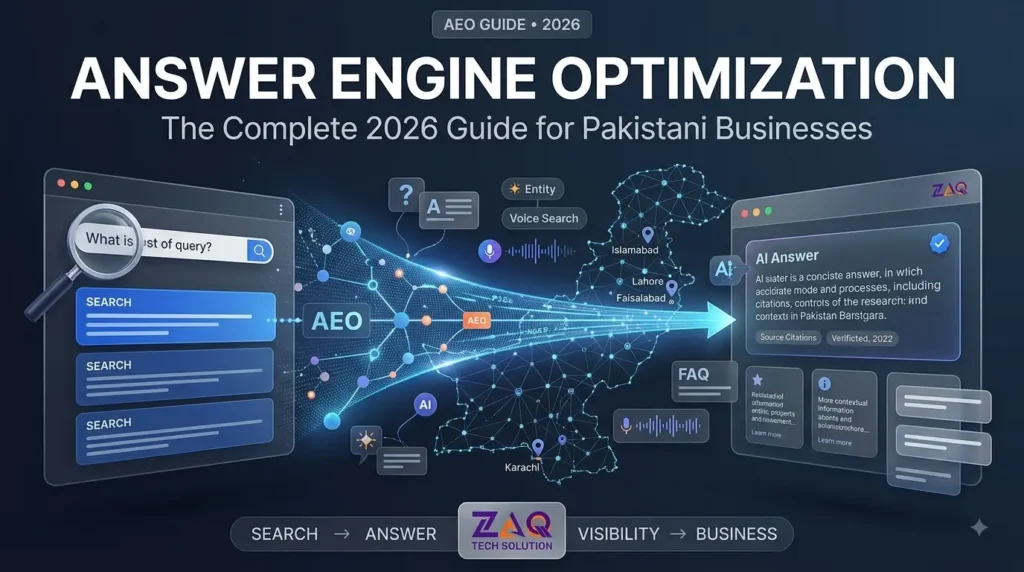
Answer Engine Optimization (AEO) is the process of structuring content so AI systems and featured snippets can extract a direct, accurate answer to a user’s question without requiring a click. We covered this in detail in our full Answer Engine Optimization (AEO) guide, which breaks down implementation step by step.
What Is GEO?
Generative Engine Optimization (GEO) is the practice of optimizing content so generative AI tools — ChatGPT, Gemini, Perplexity, Claude — reference, summarize, or cite your brand within their conversational responses.
GEO vs SEO vs AEO — Full Comparison Table
The core difference is where the optimization happens. SEO targets search result pages, AEO targets direct-answer boxes and snippets, and GEO targets AI-generated conversational text across chatbot platforms.
| Factor | SEO | AEO | GEO |
| Full Form | Search Engine Optimization | Answer Engine Optimization | Generative Engine Optimization |
| Primary Platform | Google, Bing search results | Featured snippets, AI Overviews, voice search | ChatGPT, Gemini, Perplexity, Claude |
| Goal | Rank in top organic positions | Become the extracted direct answer | Get cited or mentioned in AI-generated answers |
| Content Format | Long-form, keyword-structured | Concise Q&A, direct 40-60 word answers | Authoritative, data-rich, well-sourced |
| Success Metric | Rankings, organic clicks, CTR | Snippet ownership, zero-click impressions | Citation frequency, brand mention rate |
| User Journey Stage | Awareness to consideration | Quick-answer, often mid-funnel | Research and comparison stage |
| Core Tactics | Backlinks, technical SEO, keywords | Schema markup, structured headings | Topical authority, factual accuracy, entity clarity |
| Age of Practice | 25+ years, mature discipline | Emerged with featured snippets, ~2015 onward | Emerged with generative AI, ~2023 onward |
What About AIO? The Fourth Term You’ll Start Hearing
AI Optimization (AIO) is an umbrella term some marketers use to describe the combined practice of SEO, AEO, and GEO — essentially, optimizing content for visibility across every kind of search and AI-answer surface at once.
Think of AIO less as a separate discipline and more as a strategic framework — it’s the mindset of treating traditional search, answer boxes, and AI chatbots as one unified visibility challenge instead of three separate projects.
How the Four Terms Relate
- SEO = the foundation (technical health, authority, indexability)
- AEO = the answer layer (structured, extractable content)
- GEO = the citation layer (AI-trusted, referenceable content)
- AIO = the umbrella strategy tying all three together.
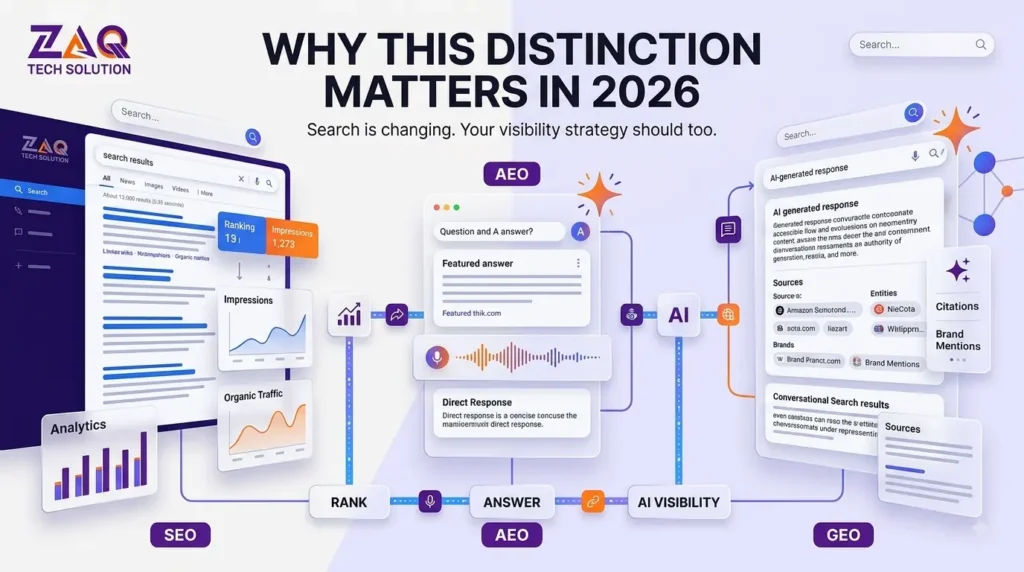
Why This Distinction Matters in 2026
Search behavior has genuinely fragmented. Some users still type into Google, others ask ChatGPT, and a growing number rely on AI Overviews sitting right above the organic results.
A few industry patterns worth noting:
- AI Overviews now appear on a substantial share of informational queries in major markets, often pushing organic listings further down the page.
- Zero-click searches — where the user gets their answer without visiting any website — continue to rise year over year.
- More professionals report using ChatGPT or Perplexity as a first research step before ever opening a search engine tab.
For businesses, this means ranking well in Google alone is no longer the finish line. If your content isn’t also structured for extraction (AEO) and citation (GEO), you risk becoming invisible in the exact moments customers are deciding who to trust.
How Each Approach Actually Works
How SEO Works
SEO relies on crawlability, backlinks, keyword relevance, and technical performance (page speed, mobile-friendliness, secure hosting) to earn trust from search algorithms over time.
How AEO Works
AEO works by formatting content into clear question-and-answer blocks, using schema markup, and placing the most direct answer immediately after each heading — making it easy for algorithms to lift and display.
How GEO Works
GEO works by building topical authority and factual consistency across your entire web presence, so generative AI models recognize your brand as a credible, citable source when generating an answer.
Where They Overlap
All three rely on the same foundation — genuinely useful, accurate, well-organized content. The differences are in formatting and platform, not in the underlying quality bar.
How to Rank in Google AI Overviews and ChatGPT
To rank in Google AI Overviews and ChatGPT, structure content around direct questions, back claims with real data, implement schema markup, maintain consistent entity information across the web, and build genuine topical authority through consistent, updated publishing.
Step-by-Step Checklist
- Identify the real questions your audience asks — use “People Also Ask,” Reddit threads, and customer queries as research sources.
- Answer each question in 40-60 words immediately under its heading.
- Add supporting depth — lists, tables, examples — right after the direct answer.
- Implement FAQ and Article schema on every important page.
- Keep information consistent across your website, Google Business Profile, and social bios.
- Publish original insights or data — AI models favor sources that add something new, not reworded content.
- Earn credible backlinks and mentions from other trustworthy Pakistani and international sites.
- Update content regularly — freshness is a measurable trust signal for both Google and AI crawlers.
Table: What Each AI Platform Prioritizes
| Platform | What It Rewards Most |
| Google AI Overviews | E-E-A-T signals, structured data, snippet history |
| ChatGPT (with browsing) | Source credibility, clarity, recency |
| Perplexity | Citation density, verifiable facts |
| Gemini | Entity consistency, Google index strength |
| Claude | Well-structured, factually precise, source-transparent content |
Benefits of Combining SEO, AEO, and GEO
Running all three together — rather than picking just one — compounds your visibility instead of splitting it.
- Wider funnel coverage: SEO captures broad searchers, AEO captures quick-answer seekers, GEO captures AI-research users.
- Stronger brand trust: Appearing consistently across search results and AI answers reinforces credibility.
- Future-proofing: As AI search adoption grows, brands already structured for it won’t need to scramble later.
- Better content ROI: The same well-structured content can serve all three purposes at once — you’re not building three separate content strategies.
GEO, SEO, and AEO Agency Services in Pakistan
Pakistan’s digital marketing space is still largely SEO-focused, which creates a real opportunity for early movers in AEO and GEO.
ZAQ Tech approaches this as one integrated discipline rather than three separate services, building question-first content architecture and schema markup directly into its SEO services in Pakistan, with dedicated coverage across Islamabad, Rawalpindi, Lahore, and Karachi.
For a deeper breakdown of the AEO side specifically — including local strategy for Pakistani businesses — see our detailed Answer Engine Optimization (AEO) guide.
What to Look for in an AI Search Optimization Agency
- Proven experience with schema markup and structured data
- A track record of ranking content in featured snippets
- Transparent reporting on both organic rankings and AI-visibility testing
- Local market understanding — Pakistani search behavior differs from Western markets in language mix, device usage, and platform preference.
Cost of AI Search Optimization in Pakistan
Direct answer: Combined SEO, AEO, and GEO strategy in Pakistan typically ranges from PKR 30,000 to PKR 180,000+ per month, depending on business size, competitiveness of the industry, and whether content creation is included.
Most agencies bundle these disciplines into broader digital marketing packages and SEO packages rather than pricing GEO or AEO as fully standalone products, since the underlying work — content, schema, technical SEO — overlaps heavily across all three.
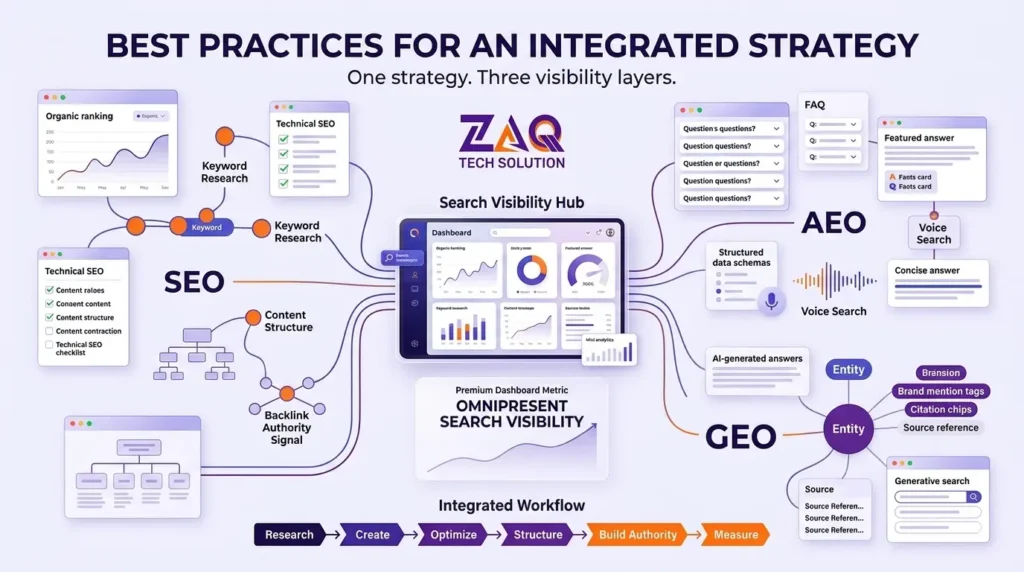
Best Practices for an Integrated Strategy
- Start with technical SEO health. No amount of AEO or GEO formatting fixes a slow, uncrawlable website.
- Build content in question clusters, not isolated articles — group related questions under one topic pillar.
- Treat schema markup as non-negotiable, not an optional extra.
- Audit AI visibility manually every month by asking ChatGPT, Gemini, and Perplexity questions relevant to your industry.
- Keep author and brand information consistent everywhere — this strengthens the entity signals AI models rely on.
- Refresh cornerstone pages quarterly instead of only publishing new content.
Common Mistakes Businesses Make
- Treating AEO and GEO as replacements for SEO instead of extensions of it
- Skipping schema markup because it feels technical or unnecessary
- Writing generic, reworded content with no original insight or local relevance
- Ignoring page speed and mobile experience, which still influence AI crawler trust
- Expecting overnight results — authority-building for AI citation takes consistent months of work, not days.
FAQs
Q1: What is the difference between SEO, AEO, and GEO?
A: SEO optimizes for search engine rankings and clicks, AEO optimizes for direct-answer extraction in snippets and AI Overviews, and GEO optimizes for citation within AI chatbot responses like ChatGPT and Gemini.
Q2: Is GEO more important than SEO in 2026?
A: No, GEO doesn’t replace SEO — it builds on it. Strong technical SEO and site authority remain the foundation that both AEO and GEO strategies depend on.
Q3: What does AIO mean in digital marketing?
A: AIO, or AI Optimization, is an umbrella term describing the combined strategy of SEO, AEO, and GEO, aimed at maximizing visibility across traditional search, answer boxes, and generative AI platforms simultaneously.
Q4: How do I know if my content is being cited by ChatGPT or Gemini?
A: Manually test relevant questions in each platform and note whether your brand, data, or content appears. There’s currently no single automated tool that tracks this comprehensively across all platforms.
Q5: Can a small business in Pakistan compete with GEO and AEO?
A: Yes. Since AEO and GEO competition remains relatively low across Pakistani markets, small businesses that structure their content well now can outperform larger, slower-moving competitors in AI visibility.
Q6: Does schema markup really affect AI Overviews and ChatGPT rankings?
A: Yes. Structured data helps both search engines and generative AI models understand content meaning and context more reliably, increasing the likelihood of being selected as a source.
Q7: How long does it take to see results from combined SEO, AEO, and GEO efforts?
A: Most businesses see early snippets or AI-visibility movement within 6-10 weeks, with stronger, more consistent citation authority building over 3-6 months of sustained effort.
Q8: Which is easier to implement first — AEO or GEO?
A: AEO is generally easier to implement first since it relies on structural changes like headings, schema, and concise answers, while GEO depends more on long-term topical authority and citation-worthy content.
Conclusion
GEO, SEO, and AEO aren’t competing strategies — they’re three layers of the same visibility challenge, each targeting a different way people now search for answers. The businesses that treat them as one integrated approach, rather than picking a single acronym to chase, will be the ones showing up everywhere their customers are looking — Google, ChatGPT, Gemini, and beyond.
If you want a practical, integrated SEO, AEO, and GEO strategy built for the Pakistani market, ZAQ Tech’s team — already delivering results through its SEO services in Islamabad and across Pakistan — can help you build a content foundation ready for every search surface.
Pingback: Optimize Website for ChatGPT and AI Search | AI SEO Services